Full-Body Strength Over 50: The Three-Exercise Workout You Can Do at Home

Mitch - Be Mobile Physiotherapy
Mitch is a physiotherapist with over 23 years' experience helping adults aged 55+ exercise safely, including when they're managing pain or chronic conditions. He is the Founder and CEO of Be Mobile Physiotherapy, a physio-led exercise company offering online and in-person programmes that keep older adults strong, confident, and able to enjoy life with the people they love.
Read Mitch's full bio →


Maybe getting a bit stronger has been on your list for a while now, and something keeps getting in the way.
Perhaps you're not sure where to begin. Perhaps the thought of a gym, a rack of equipment, or an hour you don't have, is enough to put the whole thing in the too-hard basket. Or perhaps you've quietly decided that proper strength training is for other people, not for you.
We get it. That's a fair place to be.
Here's what we want you to know straight away. You do not need a gym, a spare hour, or a single machine to train your whole body. You need three movements, a bit of floor space, and a few objects you already own.
The reason three is enough comes down to how these exercises are built. Most people picture strength work as one muscle at a time: a machine for the arms, a machine for the legs, a long list to plod through. These three are different. Each one is a compound movement, which is a friendly way of saying it trains several muscle groups at once, the way your body actually works in real life.
Nothing you do around the house uses one muscle on its own. Standing up from a chair, carrying the shopping, lifting a bag onto a high shelf: every one of those is a team effort. Train these movements and you reach the muscles behind all of them.
Three movements, a few minutes, and almost every major muscle group gets a turn.
Let's break down why that matters after 50, then walk through all three.
Why Strength Training Earns Its Place After 50
Here's the part worth slowing down for. From around our 50s, the body starts shedding muscle quietly in the background unless we give it a reason to hold on. Physios call that age-related muscle loss sarcopaenia, and left alone it's what slowly turns easy jobs into a struggle: getting off the floor, carrying a case up a flight of stairs, lifting a grandchild for a cuddle.
The reassuring part is simple. Muscle responds to being asked to work, at absolutely any age.
Walking every day? Wonderful for your heart. It just doesn't ask your muscles to get stronger, which is a different job altogether.
Think about where whole-body strength quietly shows up in a normal week:
- Rising out of a low, soft chair without pushing off your hands.
- Carrying two bags of shopping in from the car.
- Lifting a case into the overhead locker, or a bag of potting mix out of the boot.
- Catching your balance when you misjudge a step off the kerb.
Train these three movements and you're training the exact strength those moments call on.
Is This Safe for My Back and My Balance?
If bending to lift something already makes you wary, or your balance isn't quite what it was, the words deadlift and lunge can sound like an accident waiting to happen.
We always come back to a plain "risk vs reward" look here, so let's be honest about both sides.
What is the risk of not doing this? Your strength keeps fading in the background. The floor gets harder to lift from, the stairs get harder to climb, and your balance has less to fall back on when something catches you off guard. Over time those small losses add up to a much bigger one: your independence.
What is the risk of doing this? Low, as long as you start at a sensible level. On the lunge, a shallow step and a hand near the bench takes care of any wobble. On the deadlift, you choose the weight and how far you bend, so you are always working well inside your comfort. On the back question in particular, the reassuring news from the clinic is this: a bit of bend in your back or a flat back are both fine. You simply lift in the way that feels strong and steady for you.
The motto we come back to for everything is the same one: start low, go slow. Begin where the last few reps feel like a real effort but your form stays consistent, and build from there. There's no prize for rushing.
This guide is for educational purposes only and should not replace specific advice from your local health professional.
A reminder from our team"The deadlift is the one people are most nervous about, and I always want to take the fear out of it. All a deadlift really is, is picking something up off the floor, which you already do most days without a second thought. We just do it on purpose, with a weight you can manage, so your body stays strong at it. Start light. A backpack with a couple of books in it is a perfectly good place to begin, and you can always add more once it feels easy."
Prefer to follow along instead of working from a written guide? Our free 55+ Video Series walks you through full strength workouts step by step, with our physio team demonstrating every movement and every modification, so you can pick the version that's right for you.
Watch the Free Video Series →The Three Exercises
Here are all three, each with a gentle starting version and a clear way to make it harder as you get stronger. Brodie, one of our physios, demonstrates the lot in the video above. Start where the movement feels manageable, keep something sturdy within reach, and take your time.
1. The Reverse Lunge and Press
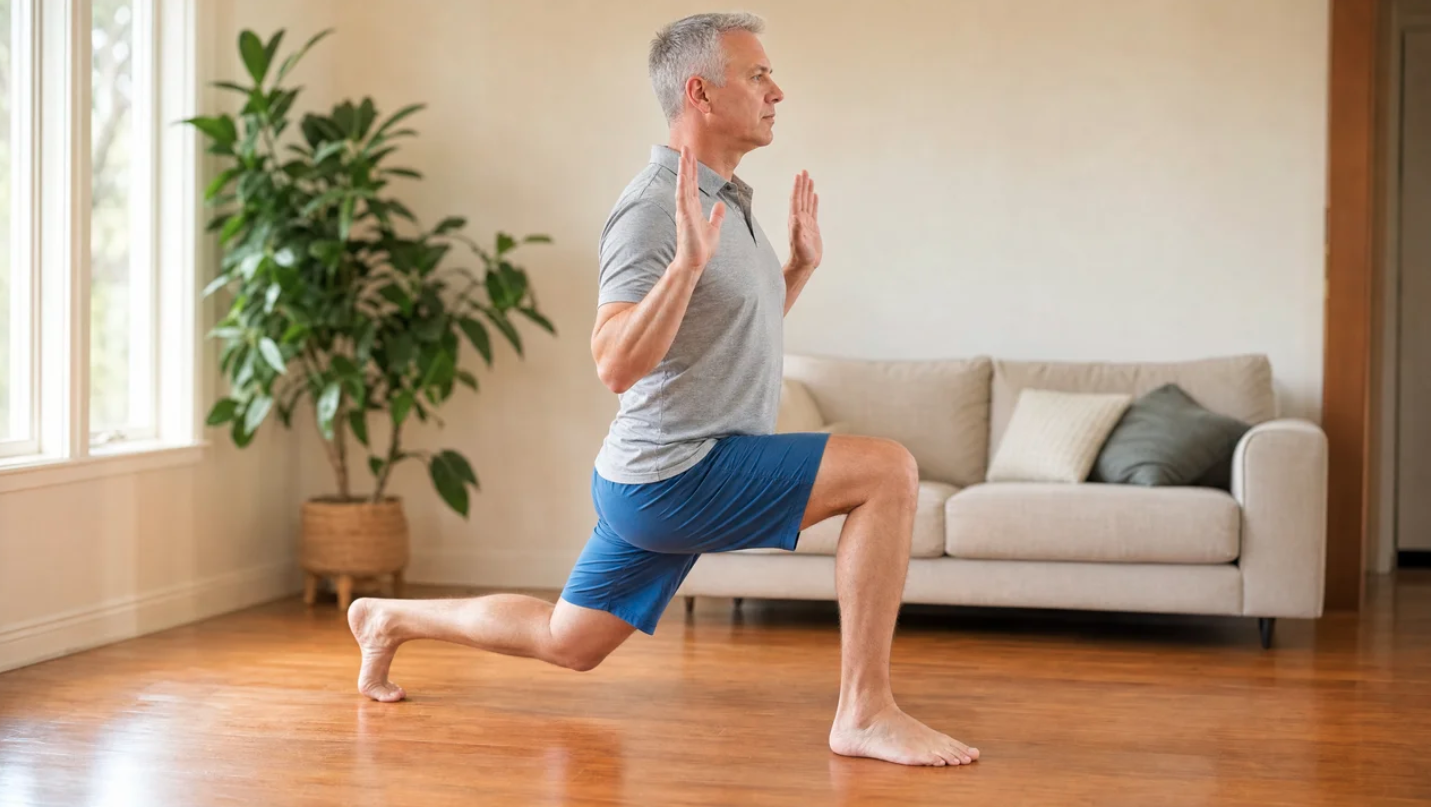
This one earns its place by doing two jobs at once. Your legs do the stepping and lowering while your arms press overhead, so you're working your lower body, your shoulders and your balance in a single movement. A simple win.
How to do it, a simple starting version:
- Stand tall with your hands up at shoulder height.
- Step one foot back into a shallow lunge, keeping each foot on its own "train track" rather than on a tightrope.
- Step that foot back in and press both hands up overhead.
- Lower your hands and swap legs. Alternate sides as you go.
To progress: lower a little deeper into the lunge, then add weight when you're ready. A dumbbell in each hand works well, or hold a backpack, a kettlebell or a filled shopping bag out in front of you and press it up with each rep.
Steadiness tip: if you feel unsteady, that "train track" idea usually sorts it out. Most wobbles come from stepping back onto an imaginary tightrope, with both feet crowding one line. Give each foot its own lane and the whole movement settles down.
2. The Mountain Climber
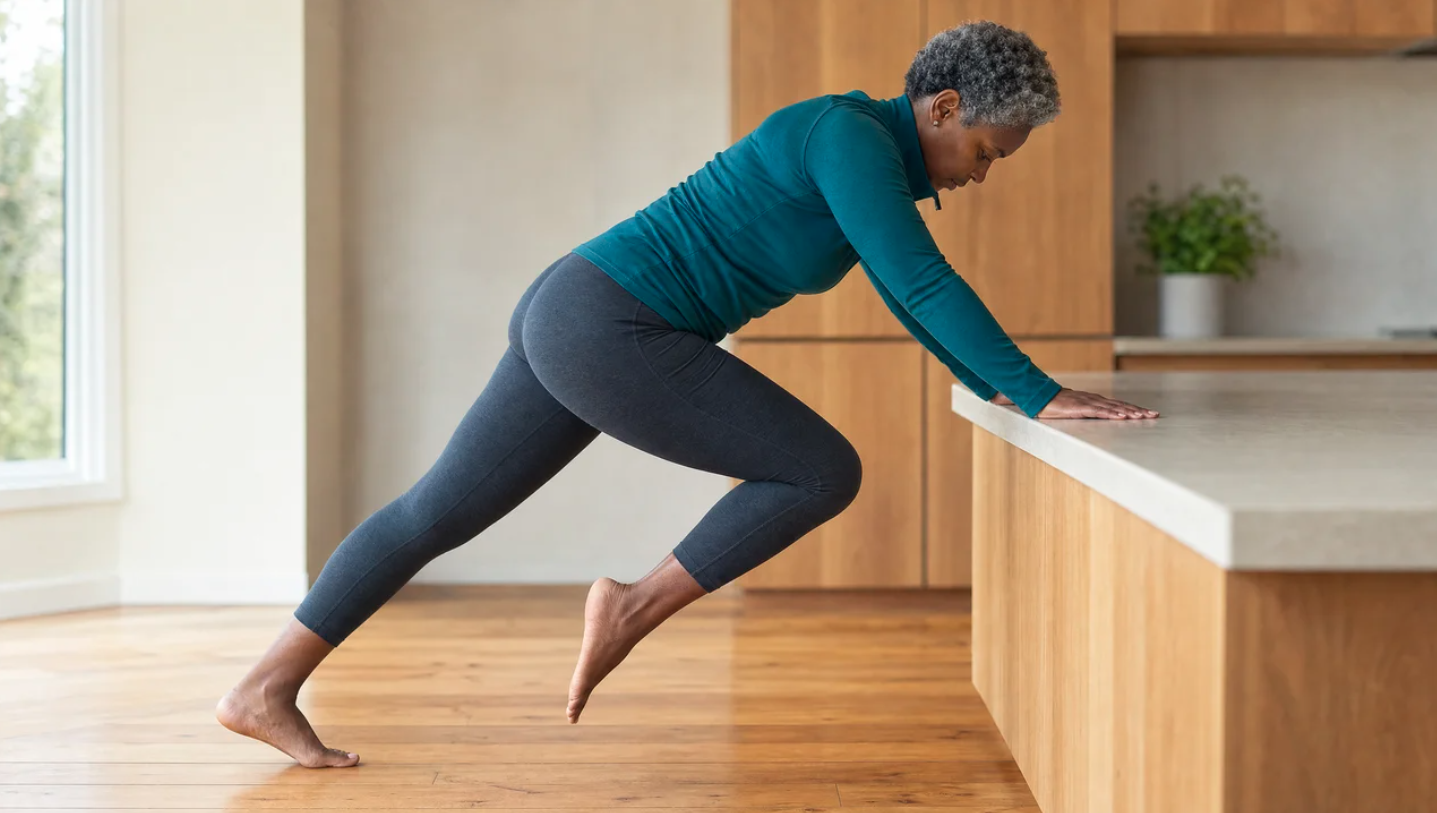
Don't let the name put you off. Bear with us, because this one is far friendlier than it sounds, and you get to choose exactly how hard it is. The mountain climber mainly builds strength through your middle, the muscles that hold you steady and upright, with some useful work for your chest, shoulders and arms along the way.
How to do it, a simple starting version:
- Place your hands on a sturdy kitchen bench or table. The higher the surface, the easier it is, so the kitchen bench is the gentlest place to start.
- Step your feet back until your body makes a fairly straight line from your shoulders to your feet. Don't let your hips sag, and don't let your bottom lift up into the air.
- From that steady position, draw one knee up towards your elbow, then swap. Keep alternating.
- Only lift each knee as far as feels comfortable. Part way is completely fine.
To progress: move to a lower surface, like the arm of a solid couch. When that feels manageable, take it all the way down to the floor for the hardest version.
3. The Deadlift
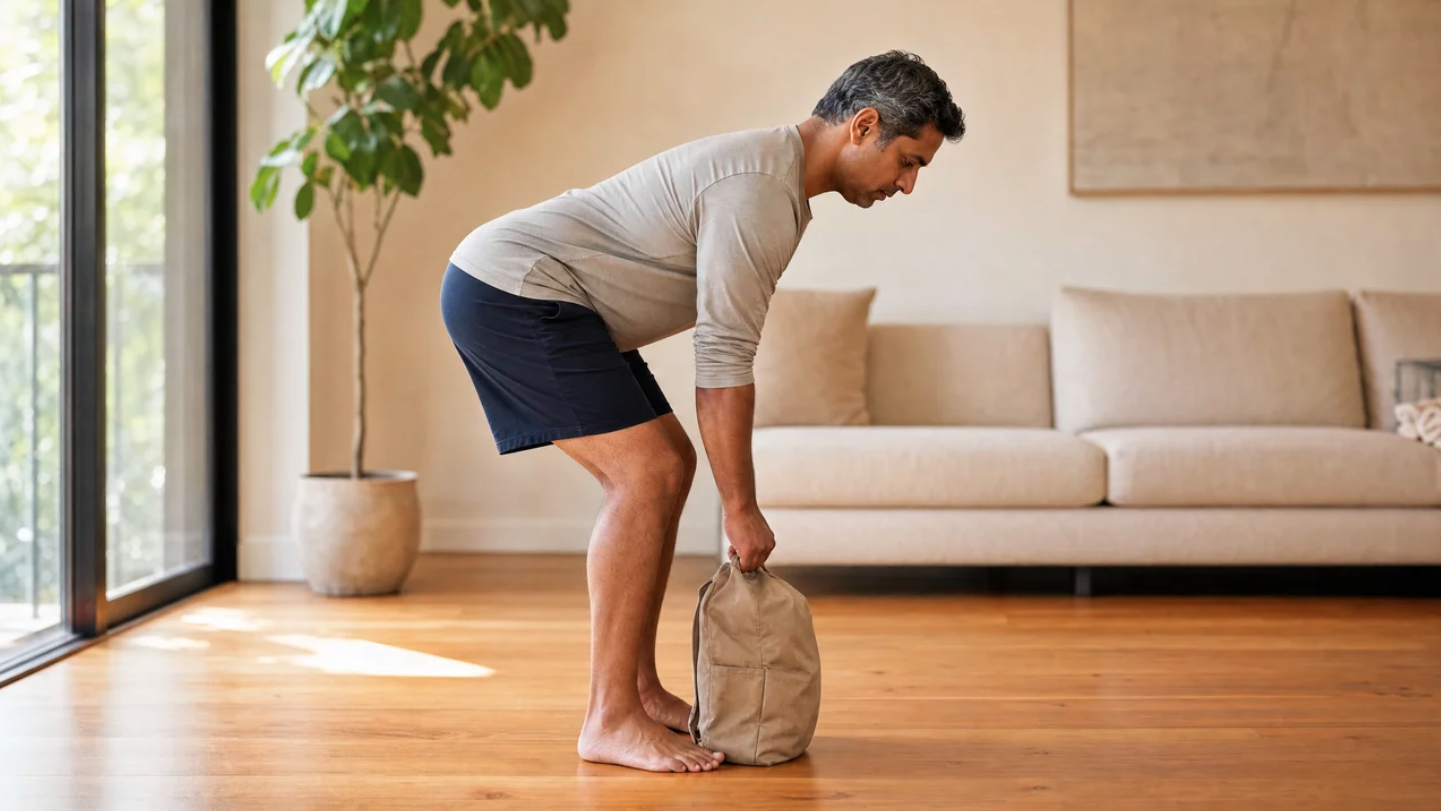
The word deadlift can bring up images of competition platforms, gym chalk and enormous barbells. Put all of that aside. A deadlift isn't a gym stunt. It's the everyday act of picking something up off the floor, done on purpose and with good strength. It's also one of our team's favourites, because almost nothing carries over into real life better.
How to do it, a simple starting version:
- Put a weight on the floor between your feet. A backpack loaded with a few books is a great starting point, because it sits taller off the ground and saves you bending as far.
- Bend down, take hold of the weight, and stand up tall with a proud chest at the top.
- Lower it back down under control. That's one rep.
- A little bend in your back or a flat back are both fine. Lift in whatever way feels strong and steady for you.
To progress: use a lower object so you bend a bit further, or reach for something heavier like a kettlebell or a pair of dumbbells.
A reminder from our team"If I could pass on one thing, it would be to resist the urge to throw yourself at all three on day one. Pick the easiest version of each, get comfortable with how they feel, and let your body catch up. The people who stick with it are almost never the ones who went hardest in week one. They're the ones who started gently and simply kept turning up. Slow and steady wins this one every time."
Prefer a guided routine with the pacing built in? That's exactly what our free 55+ Video Series is for, with our physio team demonstrating every movement and modification so you always know you're at the right level.
Start the Free 55+ Video Series →Putting It All Together
You don't need much to make a start. A few minutes, two to three times a week, is enough to begin building real full-body strength.
A simple way to run it:
- Do all three exercises, one after the other: reverse lunge and press, mountain climber, then deadlift.
- Aim for 2 to 3 rounds of 30 seconds on each, resting whenever you need to.
- Pick the version of each that makes the last few seconds a genuine effort while your form holds.
- Every couple of weeks, look for one small step up: a deeper lunge, a lower surface, a heavier bag.
Done consistently, the results turn up in ordinary moments. The shopping feels lighter. The low chair no longer needs a hand. The step you misjudge no longer sends your heart racing.
The Bottom Line
Building strength in your legs, back, core and arms comes down to one thing: staying independent. Everyday strength is what allows you to keep doing the things you love, on your own terms, for as long as possible.
You don't need a gym membership or a complicated workout plan to stay capable. Just three simple exercises, a few everyday household items, and a couple of spare minutes a day will make a noticeable difference.
Being able to comfortably lift, carry, step up, and stand on your own is essential for your everyday life, and it's worth protecting.
So, start right where you are today. Try the gentlest version of each movement first, and only step it up once it starts feeling easy. Your future self, still swinging the suitcase into the overhead locker, will be glad you did. 💪
Ready to get started? Our free 55+ Video Series includes complete follow-along workouts built around strength exercises like these, with guidance from our physio team so you can build confidence safely from day one.
Get the Free 55+ Video Series →