
Build Stronger Bones With Sore Joints: 3 Safe Impact Exercises for Over 55s

Ollie - Be Mobile Physiotherapy
Ollie is a physiotherapist at Be Mobile, passionate about changing society's misconception that older adults shouldn't lift weights. He writes most of our articles on strength, balance and confidence for the 55+ community.
Read Ollie's full bio →


A practical guide from the Be Mobile Physiotherapy team on how to get the bone-building benefits of impact exercise, even when your knees, hips or back complain about jumping.
Maybe you've been given some advice lately that feels impossible to follow.
Perhaps your doctor has told you that to improve your bone density, you need to be doing impact exercises. Perhaps your physio has mentioned stomping, skipping or even jumping. Or perhaps you've read that a gentle walk, as good as it is, isn't quite enough on its own to keep your bones strong.
Meanwhile, your knees, your hips or your back are telling you that jumping and jarring is the absolute last thing you should be doing. So you're stuck in the middle, wondering who on earth to listen to.
If that sounds familiar, you're in exactly the right place. This tug of war between building bone and protecting sore joints is one of the most common frustrations we hear about, because the advice seems to contradict what your body is telling you.
So here's the good news, right up front. Impact isn't an on and off switch that you either flick or you don't. It's a volume dial, and you get to choose the setting.
You don't need big, jarring jumps to send your bones the signal to grow stronger. You just need to find the setting on the dial that your joints can comfortably handle today, and nudge it up slowly from there.
Before we get to the exercises, it helps to understand why your bones want impact at all.
Why Your Bones Need Impact
Your bones are living tissue, constantly rebuilding and remodelling themselves in response to what you ask of them. Scientists call this Wolff's Law, and it simply means your bones adapt to the load they experience.
Challenge your skeleton, and it responds by laying down new, stronger bone. Leave it unchallenged, and it quietly does the opposite.
Your body strengthens bone through two main signals:
- Muscles pulling on bone. Every time a muscle contracts, it tugs on the bone it's attached to, and the bone reinforces itself in response.
- Impact from the ground. When you stomp, march firmly or jump, a force travels up through your feet, your legs, your hips and into your spine. That force is the signal that tells your body to reinforce its bone structure.
Both matter enormously. This guide focuses on the second one, because it's the signal most people with sore joints have stopped sending altogether.
Without it, your bones don't get the message to stay strong, and they naturally weaken over time.
The Volume Dial: Rethinking What Impact Means
Here's the part most people miss, and it changes everything.
You may have been led to believe that building bone density means having the volume dial turned all the way up, with big jumps and hard landings. That's simply not the case.
Think of it like this:
- Low on the dial: walking
- In the middle: firm marching and stomping
- Turned up loud: jumping and skipping
Yes, higher settings send a stronger signal to your bones. What matters far more, though, is consistency over months and years. Fifty gentle, tolerable impacts done three times a week, every week, will do far more for your bones than one heroic jumping session that leaves your knees furious and forces you onto the couch for a month.
Find your setting. Stay consistent. Nudge the dial up when your joints give you the all clear. That's the whole strategy.
Is This Safe for My Knees, Hips and Back?
It's a fair question, and probably the one that matters most. When your joints already grumble on stairs or after a long walk, deliberately thudding your feet into the ground can feel a bit like poking the bear.
So let's put both paths on the scales and weigh them honestly.
The cost of avoiding impact: your bones keep quietly losing density, year after year. It's a change you never feel happening, right up until a fall or a fracture makes it very real. Weaker bones sit near the top of the list of threats to independence later in life.
The cost of starting carefully: genuinely small. A firm march asks very little of a sensitive knee, every exercise in this guide has a gentler version sitting below it, and you control the dial the whole way through.
Weighed side by side, the scales tip heavily one way. The bigger danger here is doing nothing at all.
You're in good company on this, too. The 2024 guidelines from Healthy Bones Australia state that even for people with conditions like osteoarthritis, the bone benefits of impact exercise are achievable and can be modified to stay tolerable. Consider that your permission slip to get started safely.
As you go, use our simple traffic light rule:
- Green light (no pain): you're good to go. Carry on with your routine.
- Yellow light (mild discomfort): proceed with a little caution. Try a gentler version of the exercise.
- Red light (significant pain): stop that exercise, have a break, and drop down to an easier setting next time.
This guide is for educational purposes only and should not replace specific advice from a medical health professional.
If you are very frail, or if you have a high risk of vertebral (spine) fractures, or a recent fracture or surgery, your exercise programme may need to be modified and tailored to you. So please check with your doctor or physio before adding impact work in. For everyone else, the risk of building up carefully is small, and the reward is bone you can rely on.
A reminder from our team"The word impact scares a lot of the people I see, because they picture star jumps and burpees, so I always want to reassure them. A firm march, done with purpose, is genuine impact training. That little thud through your heel is the exact signal your bones are waiting for. You don't need to leave the ground to start building stronger bones today."
If reading about exercises isn't quite the same as seeing them, we've got you covered. Our free 55+ Video Series walks you through complete workouts step by step, with our physio team demonstrating every move, every modification and every cue, so you can find the right setting for you.
Watch the Free Video Series →The 3 Safe Impact Exercises
Here's the dial, from the gentlest setting through to supported jumping. Start at the level that feels challenging but tolerable, keep something sturdy within reach, and let the traffic light rule guide you as you go.
1. The Firm March
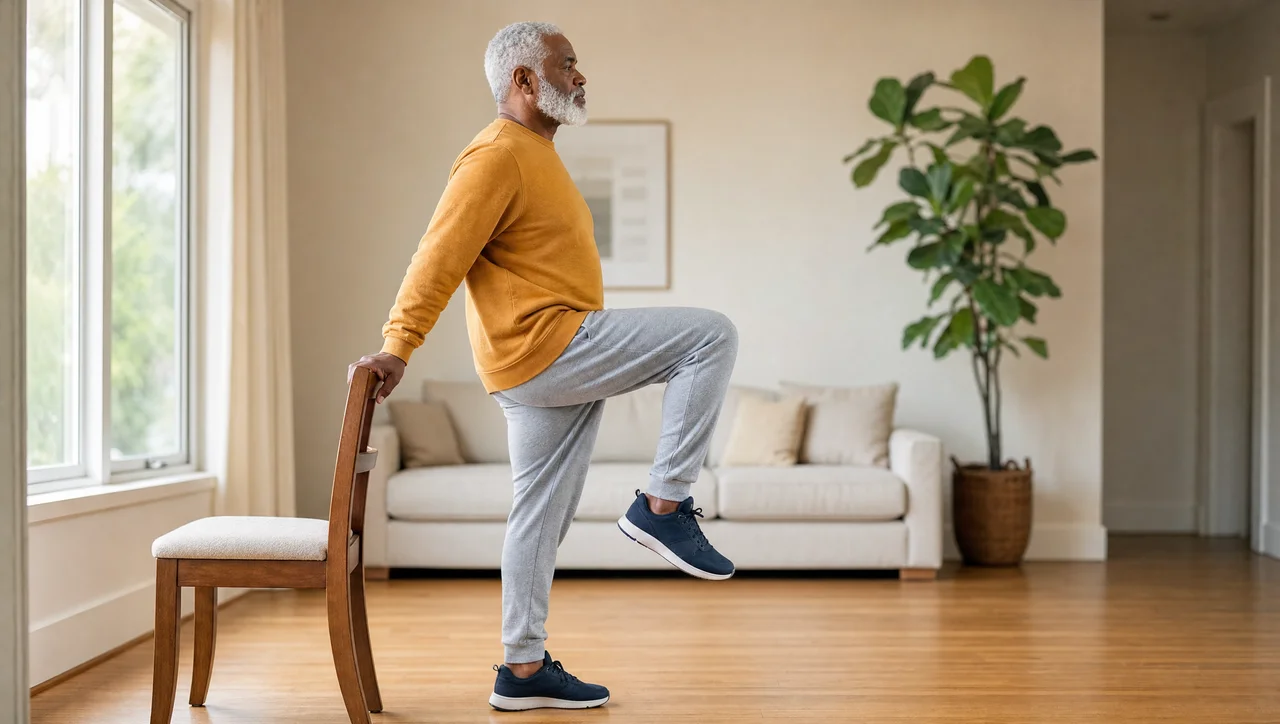
The dial on low, and the perfect entry point if your joints are sensitive. It looks like nothing much. Underneath, though, every deliberate thud is sending your bones the signal to grow stronger.
📺 Watch the firm march in the video above.
How to do it:
- Stand tall near a bench, wall or sturdy chair you can hold for support if you like, wearing comfortable, supportive shoes, like a pair of running shoes.
- March on the spot, lifting each knee and placing your foot down with a firm, deliberate step.
- Aim for a small "thud" with the ground on each step, as much as you can comfortably tolerate.
To adjust: soften your steps to make it gentler, or really amp up your stomps as your joints allow.
2. The Heel Slam

The dial turned up a notch. This one delivers the signal straight through your heels, up your legs and into your hips and spine, exactly where stronger bone matters most.
📺 Watch the heel slam in the video above.
How to do it:
- Stand tall holding a sturdy surface, like a kitchen bench, with your knees and hips softly bent, not locked out straight.
- Rise up onto the balls of your feet.
- Drop down into a controlled "thud" onto your heels.
- Land with those soft knees and hips each time. That slight bend absorbs some of the shock and keeps the movement kind to sensitive joints.
To adjust: a smaller rise and softer landing turns the dial down. A taller rise and firmer thud turns it up.
3. Supported Jumps
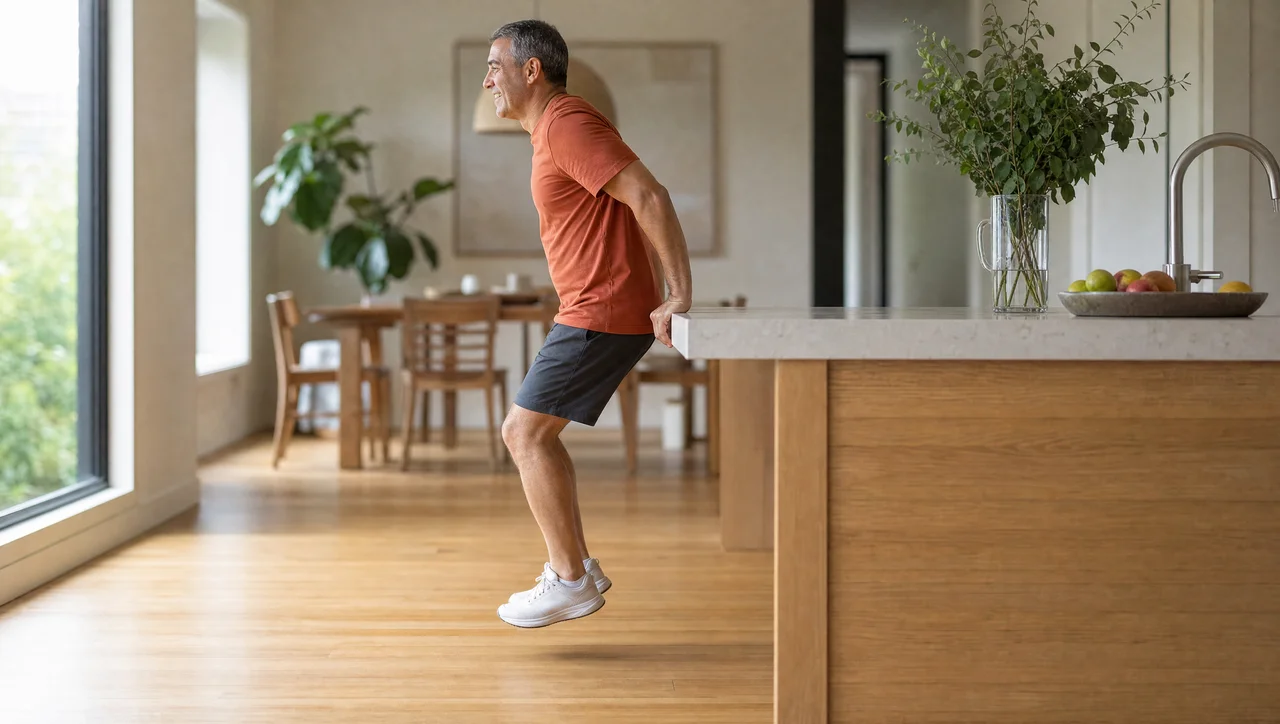
The dial turned up loud, with your hands doing some of the work so your joints don't have to take it all. Reaching this one is a real milestone, and the support makes it far more achievable than you might think.
📺 Watch the supported jumps in the video above.
How to do it:
- Stand at a kitchen bench or a heavy, stable piece of furniture, with both hands placed firmly on the surface. Keep them there throughout.
- Start with small "pogo jumps," barely clearing the ground and landing straight back down.
- Push a good amount of your weight through your hands, letting your arms absorb part of the impact.
- Land softly every time, with bent knees and hips.
- As you feel comfortable, jump a little higher. Eventually you can even push up through the bench to help you get more height.
To adjust: more weight through your hands and smaller jumps turns the dial down. Less hand support and more height turns it up.
A reminder from our team"My best piece of advice here is patience with the dial, because once you feel that first bit of progress, it's tempting to jump ahead, quite literally. Bone responds to months of consistency, not one big week. Settle at the setting your joints are happy with, let a few weeks pass, and only then nudge it up. Your bones will get there, and your joints will thank you for taking the scenic route."
Rather train alongside someone than go it alone? Building stronger bones with our physio team right there on screen, with full demonstrations, pacing and modifications built in, is exactly what our free 55+ Video Series is for.
Start the Free 55+ Video Series →Putting It All Together
No gym membership required for this one. A kitchen bench, a pair of supportive shoes and a few minutes are all it takes to start sending your bones the right signal.
A simple way to run your week:
- Pick your setting: the exercise that feels challenging but tolerable, one you can see yourself progressing from.
- Aim for around 50 impacts per session, about 3 days a week. Start smaller if you need to, with 2 sets of 5 to 10, and build up gradually.
- Check the traffic lights as you go. Green means carry on. Yellow means modify. Red means ease off and drop down a setting.
- Retest every few weeks. When your current setting feels comfortable, nudge the dial up.
One last piece of the puzzle. Impact training is one half of a complete bone-building routine. Research shows that challenging resistance training, lifting weights that genuinely test your muscles, matters just as much. Pair the two together and you're giving your bones both of the signals they respond to.
The Bottom Line
Bone density isn't something you can see in the mirror, and that's exactly what makes it easy to neglect. What it really protects is your future: your ability to catch a stumble, shrug off a knock, and stay on your feet and independent for as long as you possibly can.
Impact is the signal your bones are waiting for, and sore joints don't disqualify you from sending it. They just decide where the volume dial starts.
So give the firm march a go this week, keep the traffic lights in mind, and turn the dial up only when your joints say yes. A few months of quiet consistency from now, you'll be standing on stronger bones than you are today. 💪
Ready to get started? Our free 55+ Video Series includes complete follow-along workouts featuring bone-safe strength exercises like these, with guidance from our physio team so you can build confidence safely from day one.
Get the Free 55+ Video Series →