The "Safe" Exercise Trap for Bone Density After 55

Ollie - Be Mobile Physiotherapy
Ollie is a physiotherapist at Be Mobile, passionate about changing society's misconception that older adults shouldn't lift weights. He writes most of our articles on strength, balance and confidence for the 55+ community.
Read Ollie's full bio →


The Be Mobile Physiotherapy team reveal why a routine that never changes quietly stops protecting your bones, and share the one evidence-based principle that keeps you strong for the long run.
Perhaps it began in a consulting room. A scan came back showing osteopenia or osteoporosis, someone mentioned the word "safe," and you went home determined to find exercises that fit the description. Gentle resistance band work, a few sit to stands, a daily walk around the block.
Or perhaps you pieced the routine together yourself, searching online for movements that felt sensible and low risk, then settling into them with real commitment. Same exercises, same order, same effort, week after week, year after year.
Either way, you deserve credit. You showed up, you kept going, and consistency like that is genuinely rare.
There's a catch, though, and it's a big one. That comfortable, unchanging routine may have quietly stopped doing the very job you hired it for, because a body that is never challenged is a body that never adapts.
Here's the whole article in one line: your bones only strengthen when they're asked to handle a little more than they're used to, so a routine that stays gentle forever eventually stops sending that signal, and the truly safe path is careful, gradual progression.
Think of It as Training Wheels
Every child learning to ride a bike starts with training wheels, and rightly so. They take the fear out of the first wobbly weeks, they prevent the nasty spills, and they let confidence grow in a controlled way. Nobody would call them a mistake.
Now picture a rider who never takes them off. Ten years later they're still bolted on, and the rider has never once had to balance on their own. The training wheels did their job beautifully at the start, then quietly became the very thing holding the rider back.
Exercise works the same way.
Your bones follow a simple rule: they respond to demand. Give them a load slightly beyond what they're used to and they lay down new, denser tissue in response. Give them the same comfortable load for years on end and they receive no reason to improve, so they quietly do less and less.
That's the cruel part of the safe exercise trap. It feels productive in the moment, and your body may even feel good day to day. Underneath, though, your bone density can be sliding in the background, precisely because nothing in your week is asking your skeleton to hold its ground.
So What Does "Safe" Actually Mean?
This is where we need to rethink the word itself. Safety is not the absence of challenge, it's having a body capable of handling everything ordinary life throws at it.
Real safety means having the back and leg strength to lift your grandchildren with total confidence. It means having the power and balance to take the stairs without a second thought, carry the shopping in one trip, and get up from the floor without a plan. True safety is resilience, and resilience is built by stepping just outside your comfort zone, consistently and intelligently.
Set the two paths side by side and the maths becomes clear.
The cost of staying comfortable: your bones stop receiving their strengthening signal, density drifts downward year after year, and everyday tasks slowly become harder. The routine feels safe right up until the day your body meets a demand it hasn't trained for.
The cost of progressing carefully: genuinely small. Progression done properly moves in tiny, measured steps that you control completely, with each new level only arriving once the previous one feels easy. You never make a big leap, you simply refuse to stand still.
This approach carries serious backing. The official clinical guidelines from the Royal Australian College of General Practitioners recommend that resistance training for people with osteoporosis be moderate to vigorous and progressive. Challenge, applied gradually, sits at the centre of modern bone care rather than on the banned list.
During a session, effort is the goal; sharp pain in a bone or joint is your signal to stop and drop back a level. The next morning gives the final verdict. Feeling fine means the dose was right. Feeling sore or stiff for more than a day means ease back and rebuild gradually.
This guide is for educational purposes only and should not replace specific advice from a medical health professional.
If you've had a recent fracture or surgery, or you've been told your osteoporosis is severe, check with a professional before increasing your loads. For most people, gradual progression carries a small risk and a very large reward.
A reminder from our team"The routines that concern me most look perfectly responsible on paper. Someone's been doing the same band exercises and the same walk for five years, and they feel great about it. What they can't feel is the signal their bones stopped receiving four years ago. The fix is never dramatic: one small step up in challenge restarts the conversation with your skeleton straight away."
Oliver Halliday, 55+ Expert Physiotherapist, Be Mobile Physiotherapy
If you'd rather see a safe workout demonstrated than read about it, our free 55+ Video Series has our physio team walking you through a complete routine, with every level shown clearly.
Watch the Free 55+ Video Series →Progressive Loading: The One Tool You Need
The principle behind all of this is called progressive loading, and while the name sounds technical, the idea is refreshingly simple. Make your exercises a little bit harder over time. That's it.
Harder can mean many things: a lower angle, an extra repetition, a slower tempo, a firmer surface, a heavier object. The point is that the demand keeps inching upward, so your bones keep receiving the message to strengthen.
The push-up is the perfect way to see the principle in action, because the movement never changes while the challenge steadily climbs.
Level 1: The Wall Push-Up

The ideal starting point. Standing tall with your hands on a wall keeps the load light while you groove the movement and build early confidence.
Setup:
- Stand facing a wall, feet about hip width apart.
- Place your palms flat on the wall at shoulder height, slightly wider than your shoulders.
How to do it:
- Keeping your body in one straight line, bend your elbows and bring your chest towards the wall.
- Push firmly back to the starting position, staying tall through your hips.
The Dose: 3 sets of 8 to 12 repetitions, twice a week.
To adjust: step your feet closer to the wall to make it easier. Once 15 repetitions feel easy, the wall has done its job, and staying here forever is the trap. Time to progress.
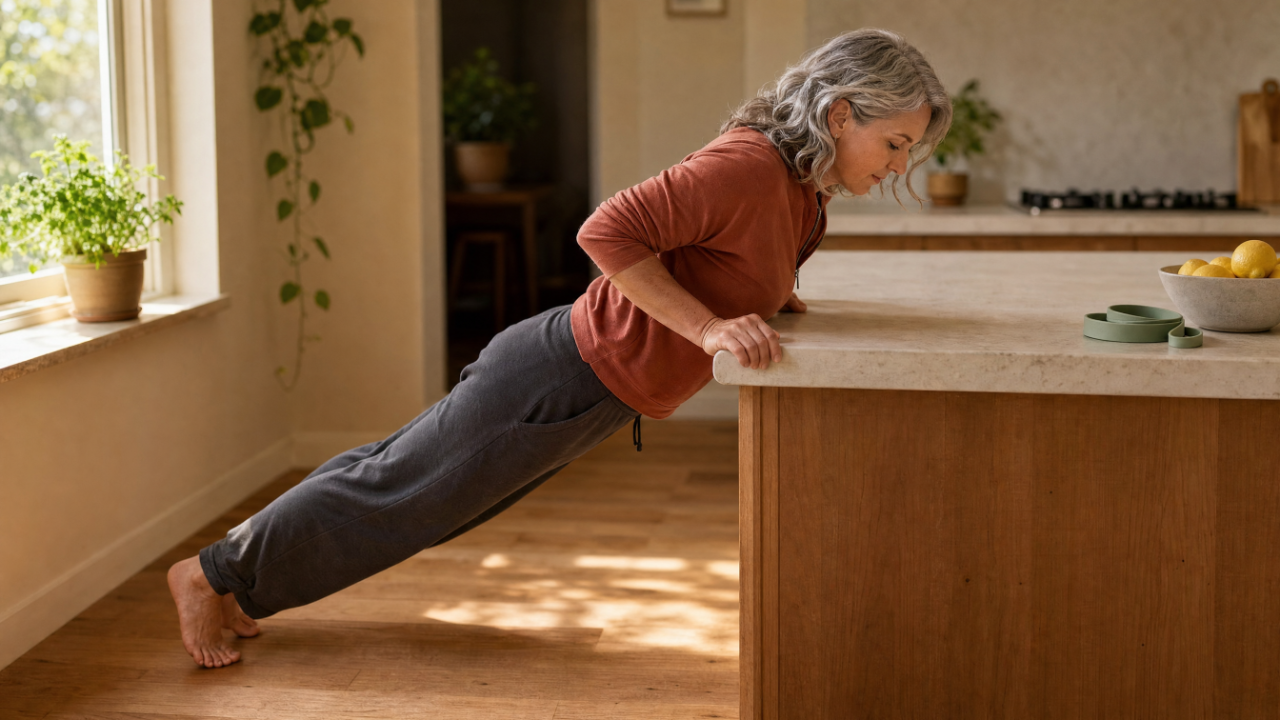
Level 2: The Kitchen Bench Push-Up

The step up. Lowering your hands from the wall to a bench drops the angle of your body, which increases the load travelling through your arms, shoulders and bones.
Setup:
- Stand facing a sturdy kitchen bench or heavy table.
- Grip the edge with your hands at about shoulder width, then walk your feet back until your body forms a straight line.
How to do it:
- Lower your chest towards the bench with control.
- Drive back up to straight arms, keeping your hips in line the whole way.
The Dose: 3 sets of 8 to 12 repetitions, twice a week.
To adjust: walk your feet closer to make it easier, or further away to raise the challenge. When 15 feel comfortable, usually after a few months, you're ready for the next rung.
Level 3: The Floor Push-Up on Knees
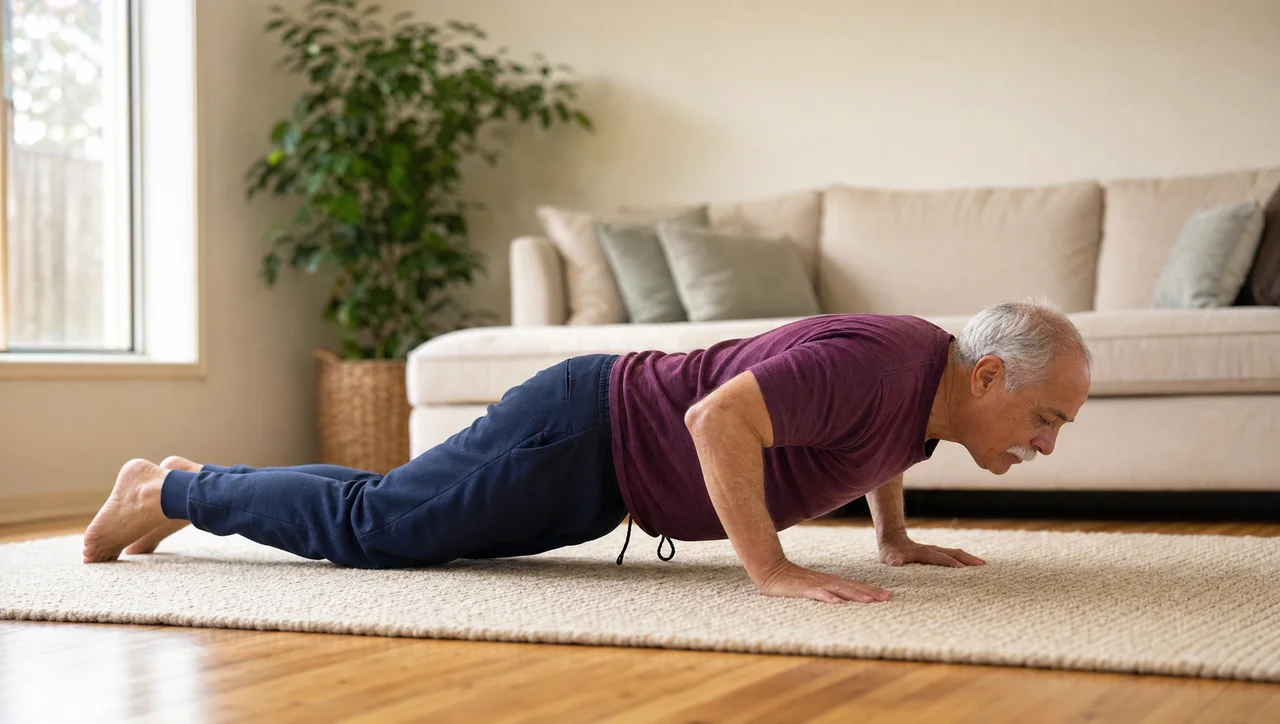
The graduation. Dropping to the floor on your knees delivers the biggest load of the three, giving your upper body and bones the strongest strengthening signal in this progression.
Setup:
- Kneel on a mat or carpeted floor with your hands under your shoulders, slightly wider than shoulder width.
- Walk your hands forward until your body forms a straight line from knees to head.
How to do it:
- Bend your elbows and lower your chest towards the floor as far as you comfortably can.
- Press back up to straight arms without letting your hips sag.
The Dose: 3 sets of 5 to 10 repetitions, twice a week.
To adjust: reduce the depth to make it easier, or slow each repetition right down to make every set count for more.
Notice what happened across those three levels. The movement stayed identical, the steps were small and manageable, and the challenge never stopped climbing. That's progressive loading, and the same thinking applies to every exercise you own, from sit to stands to carrying the groceries.
A reminder from our team"People hear the word progression and picture something intimidating, but the steps are tiny. You master the wall, then one day you try the kitchen bench and discover you're stronger than you thought. A few months later the floor doesn't scare you anymore. Nobody takes a big leap, you just keep refusing to stand still, and the results quietly stack up."
Oliver Halliday, 55+ Expert Physiotherapist, Be Mobile Physiotherapy
Want that progression mapped out for you, session by session? Our free 55+ Video Series gives you a follow-along workout with every level demonstrated by our physios, so you always know exactly when and how to step up.
Start the Free 55+ Video Series →Putting It All Together
Escaping the safe exercise trap doesn't require a new routine, just a new habit of checking your current one. A simple rhythm looks like this:
- Audit what you're doing now. Ask one honest question of each exercise in your week: does this still challenge me, or could I do it half asleep?
- Apply the rule of easy. When you can complete around 15 repetitions of something without real effort, treat that as your green light to progress, never as proof you've arrived.
- Move one small notch at a time. Change the angle, add a repetition, slow the tempo or increase the load slightly. Small, manageable steps beat big leaps every time.
- Let the next morning be your referee. Feeling fine means the new level suits you. Feeling sore for more than a day means dial it back one notch and build again gradually.
Run that loop every few weeks and the trap can never close on you, because your routine keeps evolving exactly as your bones need it to.
The Bottom Line
Gentle exercises were never the enemy. They're the training wheels, and every strong rider starts with them. The danger only arrives when they stay bolted on for years, keeping you comfortable while quietly preventing the very adaptation you're exercising for.
Be wary of any routine that never changes, because a routine that's always comfortable has stopped improving your bone density. Real protection comes from building a strong, capable, resilient body, one small step outside the comfort zone at a time.
Take a look at your routine this week, find the exercise that's become easy, and nudge it one level up. Somewhere along the way you'll realise the training wheels came off, and you barely noticed the moment it happened. 💪
Ready to progress with our physios guiding every step? The free 55+ Video Series gives you complete structured sessions led by our team.
Get Started With the Free 55+ Video Series →