Reduce Your Falls Risk: 3 Dual-Tasking Exercises for Adults Over 55

Ollie - Be Mobile Physiotherapy
Ollie is a physiotherapist at Be Mobile, passionate about changing society's misconception that older adults shouldn't lift weights. He writes most of our articles on strength, balance and confidence for the 55+ community.
Read Ollie's full bio →


A practical guide from the Be Mobile Physiotherapy team on why most balance exercises don't translate to real-world fall prevention, and three that do.
Maybe you've started thinking a bit more about your balance lately.
Perhaps a near-stumble in the kitchen made you pause. Perhaps a friend has had a fall recently and you've noticed yourself moving a touch more carefully. Or perhaps a quiet voice in the back of your mind keeps reminding you that falls are something to take seriously after 65.
That's a fair response. One in three adults over 65 has a fall every year, and falls are the second leading cause of unintentional injury worldwide. The risk is real.
Here's what we want you to know straight away. Standing on one leg in the kitchen, while useful, isn't the kind of training that actually protects you in the moment a fall is about to happen.
Let's break it down. First, an important clarification.
Balance Training Isn't What Stops You Falling
Most people picture balance training as standing on one leg, eyes closed, holding a position for as long as possible. That's single-task balance. Useful as a foundation. Not the same as what protects you in real life.
Think about how real falls actually happen. You're carrying a cup of tea. The dog barks. You turn your head while still walking. Your foot catches the edge of the rug. By the time your brain registers what's happening, you're already on the way down.
Falls happen when your attention is somewhere else. They almost never happen when you're consciously focused on staying upright.
The kind of training that genuinely reduces falls is the kind that mirrors real life: your brain busy with one thing, your body quietly handling another. Physiotherapists call this dual-tasking, and it's one of the most underused fall-prevention tools we have.
Why Dual-Tasking Beats Single-Task Balance
Think of your attention like the beam of a torch. When you point it straight at one thing, that thing is bright and clear. When you're standing on one leg with your full focus on staying steady, your balance gets the whole beam, so holding the position feels easy."
Add a conversation, a question, a calculation, or a head turn, and that beam has to split. Your balance suddenly gets far less of the light. Small wobbles you'd normally correct without noticing slip through, and that's where the trouble starts.
This is why falls almost always happen during multi-tasking moments. You're not failing at balance. Your brain is busy with everything else.
Dual-task training does three quiet but important things:
- Builds your brain's ability to share attention between tasks without dropping either
- Strengthens automatic balance responses, so they don't need full conscious attention to work
- Bridges the gap between "gym balance" and "real-world balance"
That last point is the one that matters most. Plenty of people can stand on one leg beautifully in their lounge room and still have a fall on the way to the letterbox. Dual-task training closes that gap.
"But is this really safe for someone like me?"
We get it. The idea of deliberately distracting yourself while doing balance work can sound like exactly the situation you've been trying to avoid.
We always try to take a measured "risk vs reward" attitude here. So let's look at it honestly.
What is the risk of not training this way? Your real-world balance stays mismatched with your single-task balance. The next time something distracts you in the kitchen or on the footpath, your brain still won't have practised handling it. Falls risk stays where it is, or quietly climbs as the years tick on.
What is the risk of training this way? Very low, as long as the setup is sensible. Each exercise has a gentle starting version. You can do them next to a wall, a sturdy chair, or a kitchen bench so there's always something within reach.
The motto we keep coming back to is the same one we use for everything else: start low, go slow. Begin at level one. Stay there for a couple of weeks if you need to. The point isn't to race to the hardest version. The point is to give your brain steady practice at splitting attention while staying upright.
If you've had a recent fall, a recent surgery, or you're feeling genuinely unsteady on your feet today, get a professional opinion before adding these in. For everyone else, the risk of doing them carefully is small.
This guide is for educational purposes only and should not replace specific advice from a medical professional.
A reminder from our team"The clients I see making the biggest difference to their falls risk aren't the ones with the strongest legs. They're the ones who've practised staying calm when something unexpected happens. A bump, a noise, a question from across the room. The training I prescribe most often these days is the kind that looks a bit silly, because that's exactly the kind that works."
Oliver Halliday, 55+ Expert Physiotherapist, Be Mobile Physiotherapy
Want to follow along instead of working from a written guide? Our free 55+ Video Series walks you through a full balance and fall-prevention workout step by step, with our physio team demonstrating every move, every modification and every cue, so you can pick the right version for you.
Watch the Free Video Series →The Three Dual-Tasking Exercises
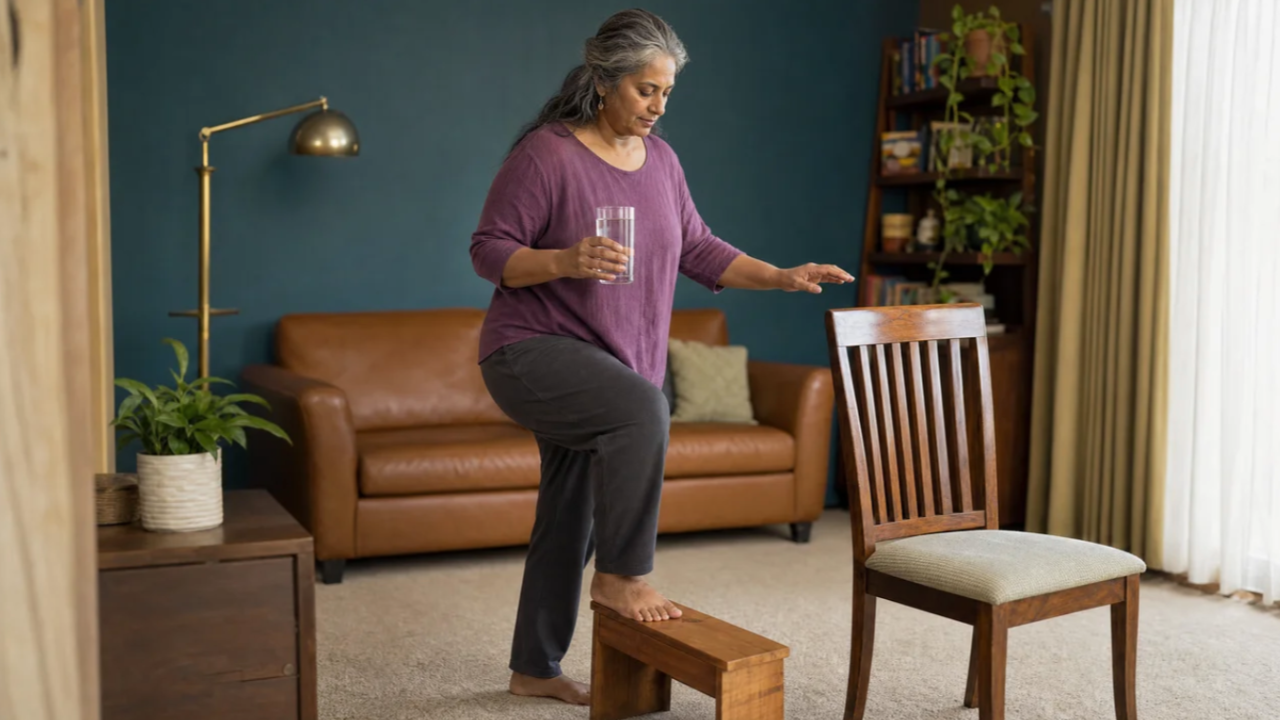
1. The Cup of Water Step-Over

This one mimics one of the most common fall scenarios in real life: carrying something while navigating an obstacle. Toys on the floor. A pet under your feet. A bump in the rug. Trained weekly, it builds the exact coordination you need for those moments.
Setup:
- Fill a plastic cup to the brim with water. The fuller, the better.
- Place a small box on the floor in front of you. A shoebox is perfect.
How to do it (four progressing levels):
- Level 1: Balance on one leg. Lightly tap the top of the box with your other foot, then step back down. Repeat.
- Level 2: Same movement, though now you hover your tapping foot in the air between taps without putting it down.
- Level 3: Step your foot completely over the box and back to the other side, without spilling the water.
- Level 4: Do the step-overs sideways, or swap the shoebox for something taller.
The Dose: 60 to 90 seconds, two to three times a week. For an added cognitive layer, switch the cup to your non-dominant hand.
A simple win if you've never done balance work this way before.
2. On and Off the Mat (Physical Plus Mental)
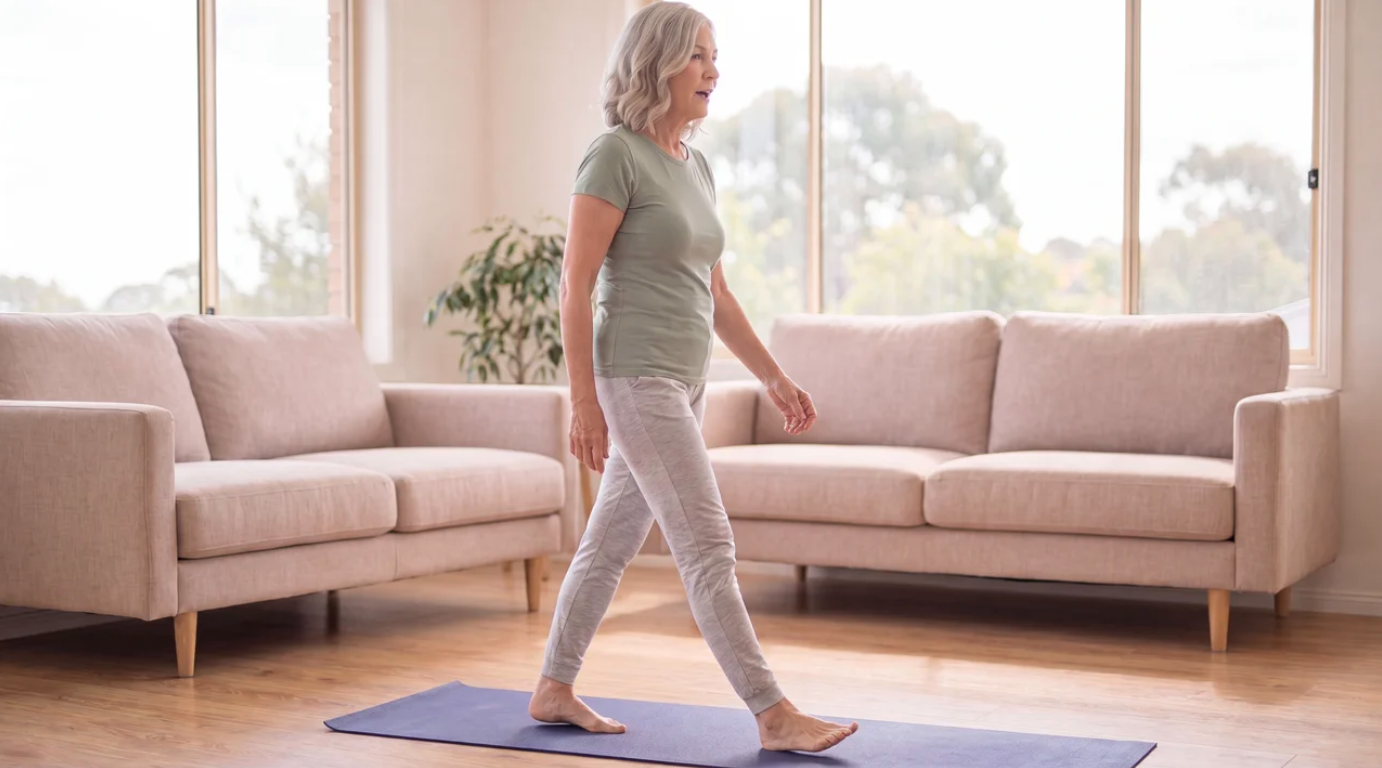
The first exercise distracts your hands. This one distracts your mind. You'll be doing a quick mental task out loud while your feet keep moving in rhythm. The combination forces your brain to genuinely split attention between thinking and moving.
Setup:
- Stand in front of a yoga mat, a doormat, or any clear line on the floor.
How to do it:
- The physical task: Step forward and backward over the line at a steady pace. Full, clear steps. Don't let your feet shuffle.
- The mental task (pick one): Start at 140 and count backwards by 7s. Or name countries alphabetically. Or name dog breeds, fruits, or capital cities in alphabetical order.
- Variation: Turn sideways to the mat and take lateral steps over the line while continuing the mental task.
The Dose: 60 to 90 seconds per round, two to three times a week.
If you stumble on the maths, slow the stepping down. The point of this exercise is to find the edge of your dual-tasking ability and live there for a minute.
3. Balance Stance with a Ball Toss
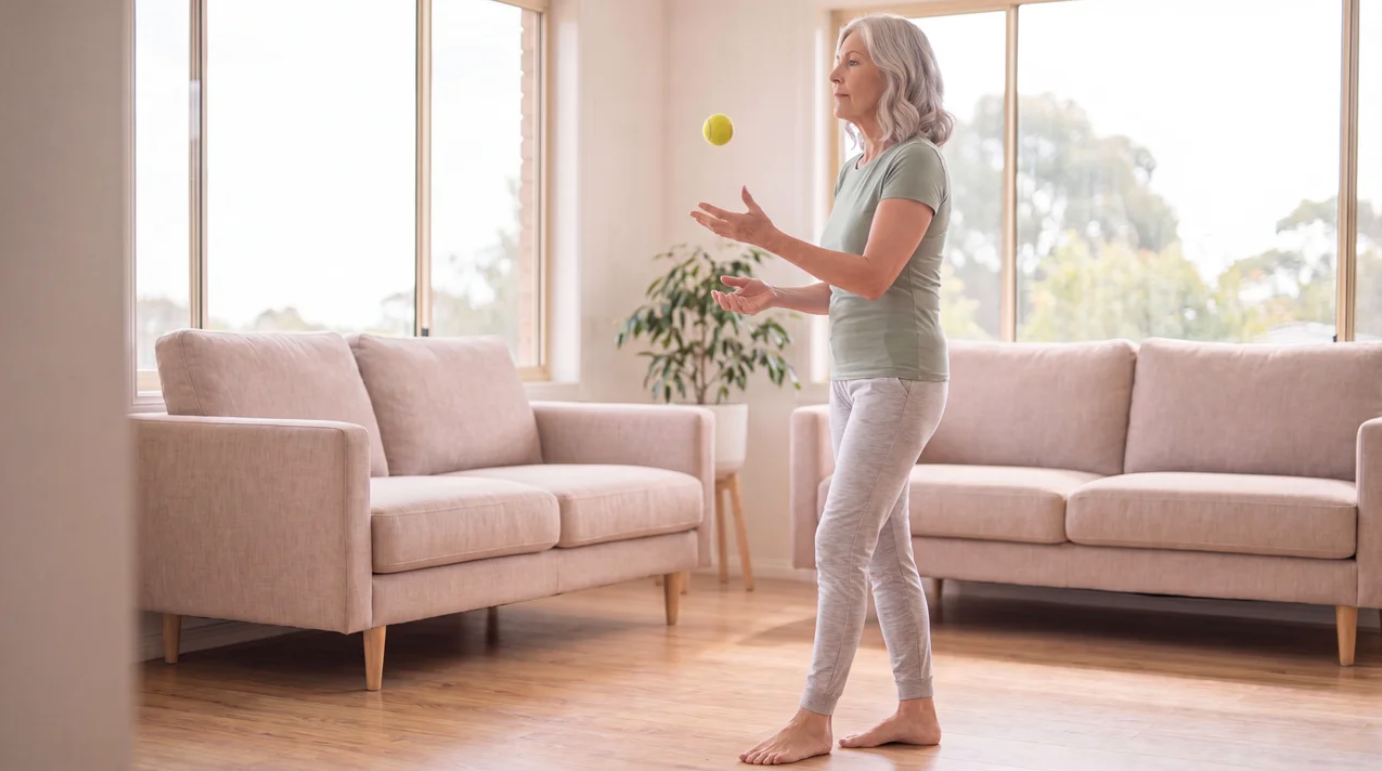
This one's a favourite of ours. It pulls your eyes away from your feet (which is what you'd normally rely on for balance) and shifts your visual focus to tracking a moving object. Done consistently, your balance reactions become more reflexive and less reliant on looking down.
Setup:
- Find a tennis ball, a juggling ball, or even an orange from the fruit bowl.
- Stand in tandem stance (one foot directly in front of the other, heel-to-toe). If you're confident, stand on one leg instead.
How to do it:
- Toss the ball gently up in front of you and catch it, while holding your stance.
- Aim for soft, repeatable throws. Don't fling it.
Variations as you progress:
- Bounce the ball on the floor instead of tossing it up.
- Toss the ball under a raised leg and catch it on the other side.
- Toss the ball against a wall, or play catch with a partner.
The Dose: 60 to 90 seconds each side, two to three times a week.
Prefer a guided, follow-along routine? If you'd like to get started alongside our physio team, with full demonstrations, pacing and modifications built in, that is exactly what our free 55+ Video Series is for.
Start the Free 55+ Video Series →A reminder from our team"When I cue a balance exercise in clinic, I'll usually start chatting to the patient halfway through. Asking about their week, their grandkids, anything. You'd be surprised how often their balance falls apart the moment they're talking. That's not a sign they're frail. It's a sign they haven't practised the thing they need most. We can all build this."
Oliver Halliday, 55+ Expert Physiotherapist, Be Mobile Physiotherapy
Putting It All Together
You don't need a special hour for this. A few minutes, two to three times a week, slotted in alongside your normal routine, is enough to start seeing real change.
A simple framework for the week:
- Cup of Water Step-Over: 60 to 90 seconds each side
- On and Off the Mat with a mental task: 60 to 90 seconds per round
- Ball Toss in Tandem Stance: 60 to 90 seconds each side
Done consistently for six to eight weeks, this style of practice has strong support in the research for improving real-world balance and reducing falls in adults over 55.
You'll start to notice small things. Less wobble when someone calls your name mid-walk. Steadier on the stairs while you answer the phone. Less of a stumble when the kettle whistles and your attention jumps.
The Bottom Line
Falls don't happen because your balance suddenly fails. They happen because your brain is doing something else, and your balance gets left behind for a split second.
The good news is that this is a skill. Like any skill, it improves with practice.
Train your brain and your body together, not separately, and your real-world balance starts showing up where it matters most.
A few minutes, a few times a week, in your own lounge room. That's all it takes to start.
Start with level 1. Keep one hand on a chair if you need it. Have a crack at the harder versions when (and only when) the easier ones feel comfortable. Your future self, the one walking confidently into their 70s and 80s and beyond, will be glad you did. 💪
Ready to get started? Our free 55+ Video Series includes a complete follow-along workout featuring balance and fall-prevention exercises, with guidance from our physio team so you can build confidence safely from day one.
Get the Free 55+ Video Series →