3 Hip Exercises to Help Prevent Fractures After 55 (Plus a Bonus)

Brodie - Be Mobile Physiotherapy
Brodie is a physiotherapist at Be Mobile whose passion for exercise started early - an active, sporty childhood, and a knee injury playing high-school rugby that put him through a heap of physio and inspired him to study it himself. He truly embodies our value of evidence-based practice and is passionate about exercise for older adults. Outside of work, you'll find him with friends, at the rugby, or reading up on sci-fi, cosmology and physics.
Read Brodie's full bio →


The Be Mobile Physiotherapy team walks you through four at-home movements that strengthen the muscles around your hips and give the bone underneath a genuine reason to grow.
Maybe a hip fracture has already touched your world. A friend who tripped in the garden, a parent whose fall changed everything, or a story from your doctor that stuck with you longer than you expected.
Or maybe it's quieter than that. A bone density scan came back with osteoporosis or osteopenia written on it, and ever since, you've caught yourself treating your hips like they're fragile.
Underneath both sits the same fear: that a fractured hip is simply what happens as you get older, and the best you can do is cross your fingers.
We see it differently. Your hip bone is living tissue that responds to what you ask of it, which means strong, resilient hips can be built on purpose, at home, with equipment as humble as a backpack full of books.
Here's the whole article in one line: when the big muscles around your hips pull hard on the bone they're attached to, the bone answers by growing stronger and denser, and that response stays available to you at any age.
Why Muscle Is the Best Friend Your Hip Bone Has
Your skeleton isn't a finished house, it's a permanent building site. A maintenance crew works on your bones around the clock, clearing out older material and laying down fresh bone in its place.
The crew takes its direction from demand. Every time a large muscle contracts hard, it tugs on the bone it's anchored to, and that tug lands on the crew's desk like a work order: this section is being used, reinforce it.
The size of the order matters:
- Light, easy movement sends small orders. The crew does the minimum to keep things ticking over.
- Hard, challenging movement sends large orders. The crew reinforces the bone to cope with the load it now expects.
The muscles surrounding your hips and pelvis, your glutes and hamstrings among them, are some of the biggest and strongest in your body. Put them to proper work and your hip bone receives the largest orders your skeleton can write.
The Catch: Easy Doesn't Count
This is where a lot of well-meaning routines quietly fall short. A movement done at a level that feels comfortable from first rep to last never places a meaningful order, so the crew never gets word to build.
The test is simple. At the end of a set, ask yourself whether you could have easily kept going. If the answer is yes, the version you're doing has become too light, and it's time to add some weight or step up to a harder variation.
Challenging doesn't mean training to collapse. It means the final few repetitions of each set feel like genuine work.
Is It Safe to Load Your Hips With Weight?
A fair thing to wonder, especially when the whole reason you're here is a bone density result. Deliberately adding weight to the very joint you're worried about can feel backwards.
Weigh the two paths honestly, though, and the picture changes.
The cost of avoiding load: the maintenance crew receives no orders, and bone density keeps drifting down year on year. A hip fracture sits among the most serious injuries an older adult can have, with recovery often measured in months and independence sometimes never fully regained.
The cost of starting carefully: genuinely small. Every movement in this guide is a pattern you already use in daily life, each one starts at bodyweight, and you decide when a few extra books go in the backpack.
Peak bodies such as Healthy Bones Australia recommend progressive resistance training as a core part of managing osteoporosis, precisely because of this muscle-on-bone effect. Start low, go slow, and use the next-morning check to keep yourself honest.
During a session, muscle burn and honest effort are welcome; sharp pain in a joint is your cue to stop and switch to an easier version. The real verdict arrives the next morning. If your hips have pulled up fine, the load was right and you can carry on. If you're noticeably sore or stiff for more than a day, drop back a level next session and build up again from there.
This guide is for educational purposes only and should not replace specific advice from a medical health professional.
If you've had a recent fracture, recent surgery, or you've been told your osteoporosis is severe, check in with a professional before loading up. For most people, the careful path carries a small risk and a large reward.
A reminder from our team"Nearly every week someone tells me they've stopped squatting because of their bones, and it's usually the opposite of what their hips need. A squat done well, at a weight you control, is one of the most productive things you can offer a hip that's losing density. Start with just your bodyweight, get each movement feeling smooth, and the backpack can wait until you're ready."
Brodie Morrison, 55+ Expert Physiotherapist, Be Mobile Physiotherapy
If you'd rather see these movements demonstrated than read about them, our free 55+ Video Series has our physio team on screen walking you through complete workouts, cues, and modifications from start to finish.
Watch the Free 55+ Video Series →The 4 Hip-Building Exercises
Grab a backpack, a few heavy books, and a sturdy bench or rail for support. Start every exercise at the easiest version, find the level that feels like honest work, and build from there.
1. The Squat
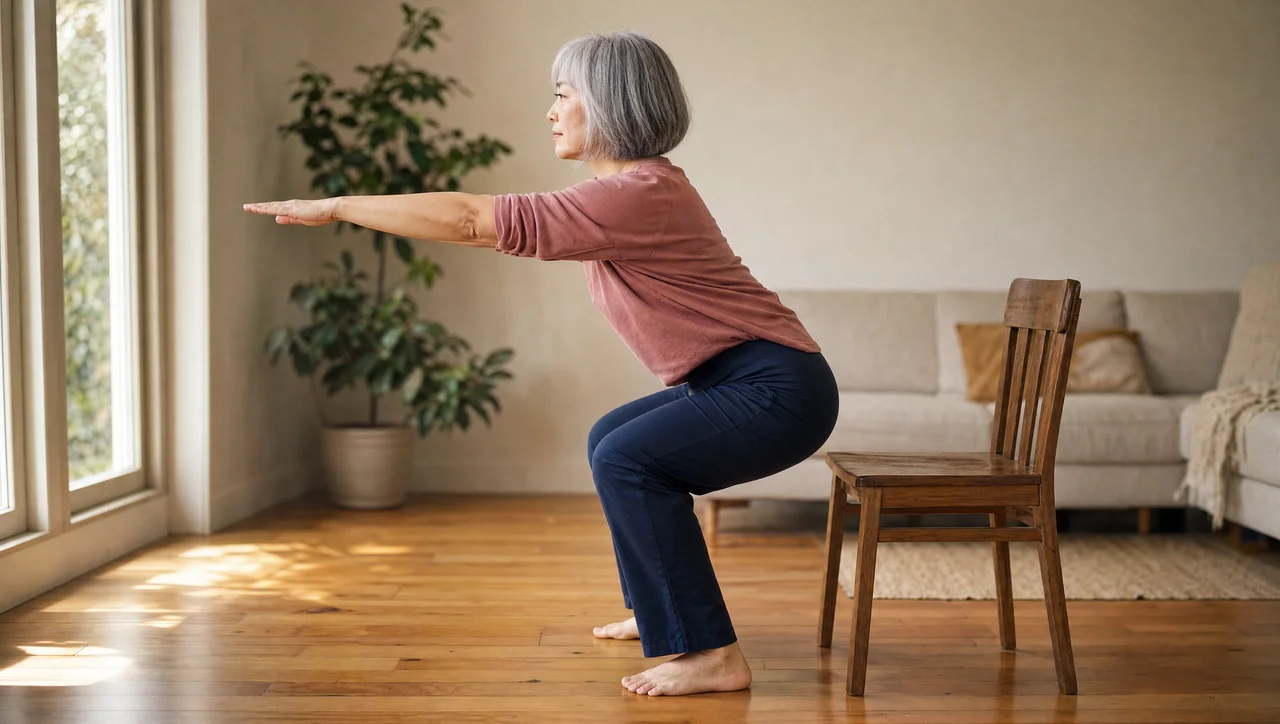
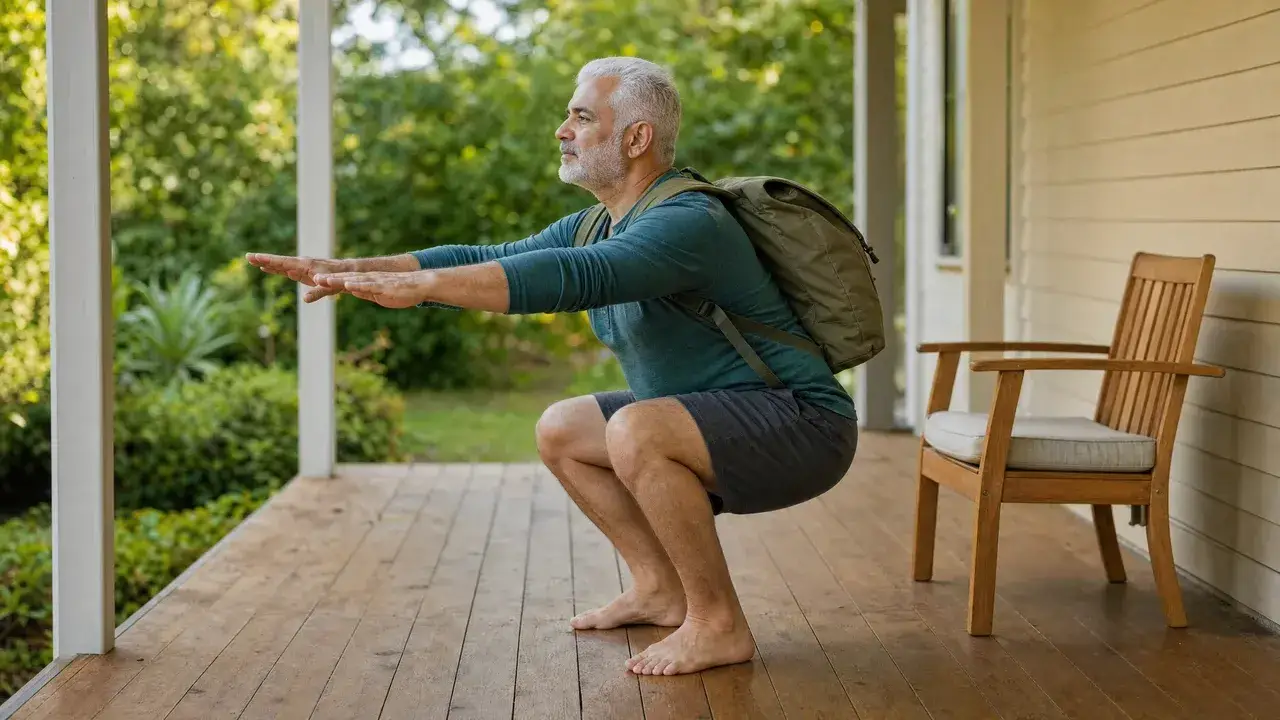
The cornerstone of the routine. It works the glutes and the other big muscles anchored to your hip bone, and it carries over directly to everyday life: getting out of a low chair, or up off the floor.
Setup:
- Stand with your feet about shoulder width apart, near a bench or sturdy chair if you'd like support close by.
- To add load, wear a backpack filled with heavy books, or hold a weight at your chest.
How to do it:
- Push your hips back and bend your knees, lowering yourself as if sitting into a chair.
- Keep your heels planted and your chest up as you descend.
- Drive through your feet to stand back up tall.
The Dose: 3 sets of 5 to 8 challenging repetitions, twice a week.
To adjust: squat down to an actual chair for an easier version, or slide more books into the backpack as you get stronger.
2. The Romanian Deadlift (RDL)
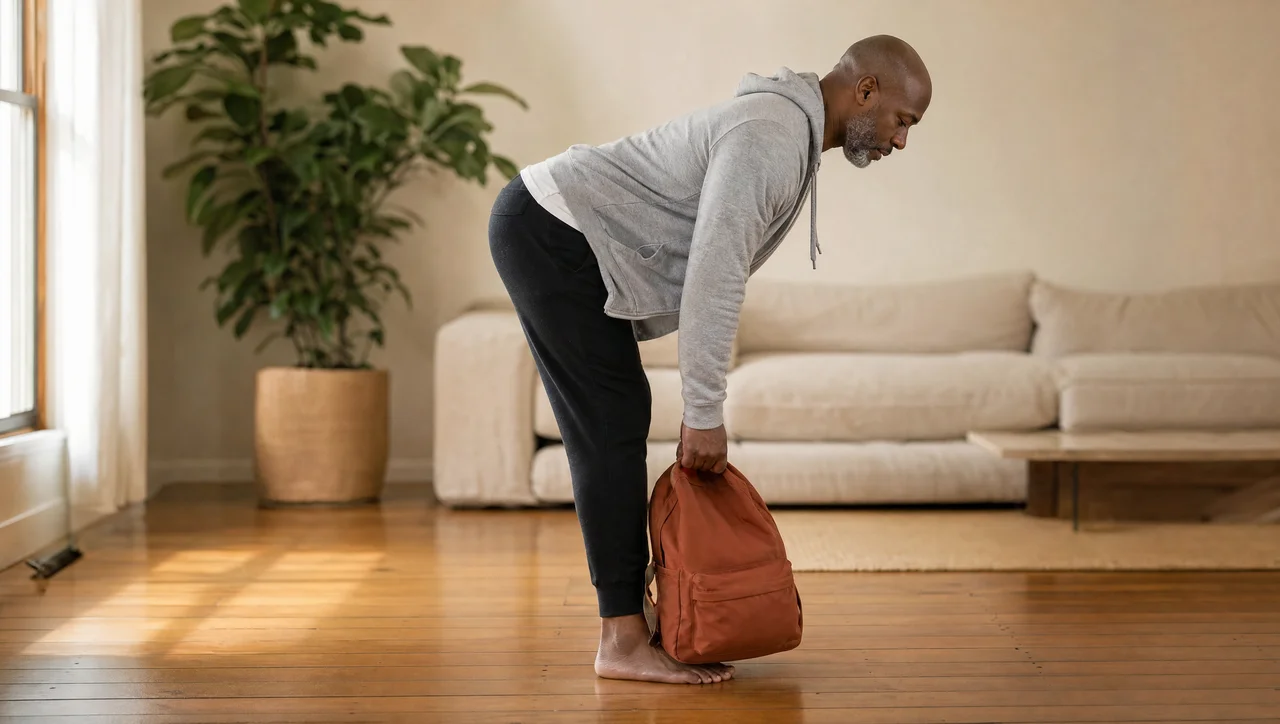
The order form for the entire back side of your body. The RDL strengthens your hamstrings, the muscles along your spine, and those all-important glutes, which pull directly on your hip bones as they work.
Setup:
- Stand tall with your feet hip width apart, holding your backpack or weights in front of your thighs.
- Keep a soft bend in your knees throughout.
How to do it:
- Push your hips back behind you, letting the weight slide down the front of your thighs.
- Keep your back fairly straight as you bow down as far as comfortable.
- Drive your hips forward to return to standing.
The Dose: 3 sets of 5 to 8 challenging repetitions, twice a week.
To adjust: shorten the range or lighten the load to ease off, or add weight and hinge a little deeper as your strength grows.
3. The Step-Up
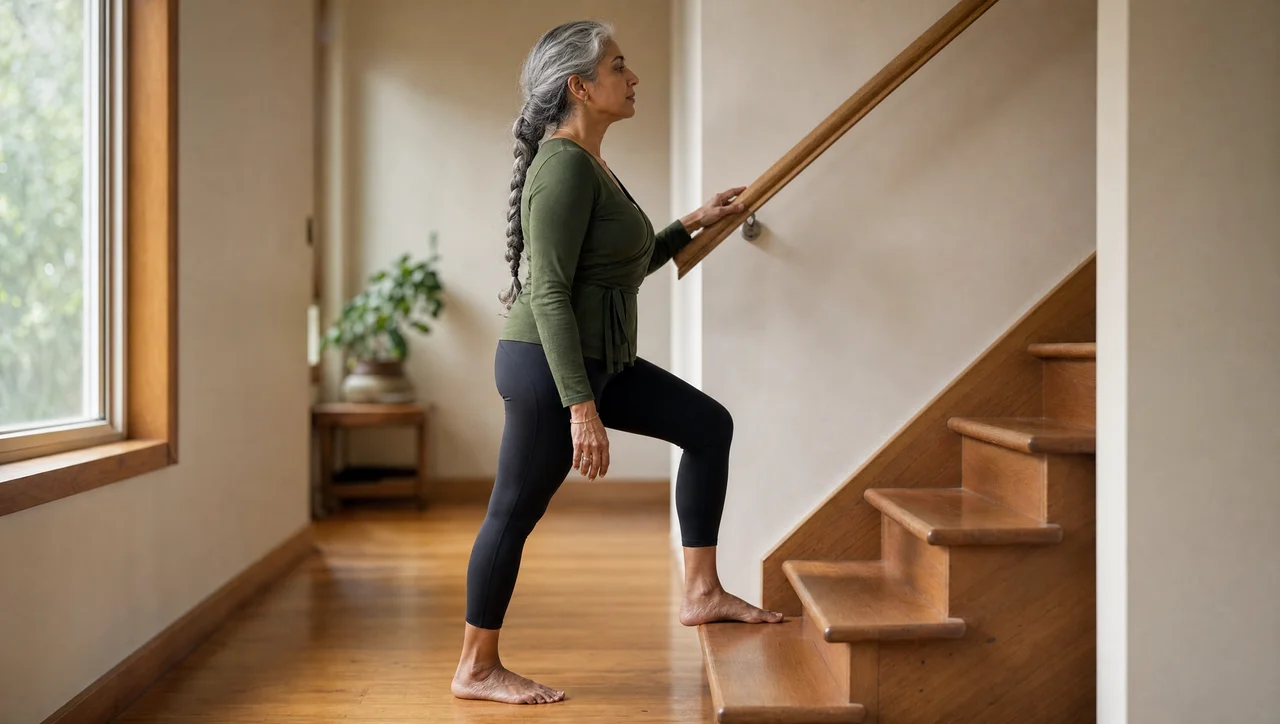
The single-leg specialist. Standing and driving up on one leg intensely loads the stabilising muscles on the side of your hip, like the gluteus medius, which runs from your pelvis to your thigh bone and keeps you steady every time you're on one foot.
Setup:
- Use a sturdy step or your bottom stair, with a handrail or wall within reach.
- Wear the backpack for extra load once bodyweight feels manageable.
How to do it:
- Place your whole foot flat on the step.
- Push through that leg to lift your body up, using the trailing leg as little as you can.
- Lower yourself back down with control.
The Dose: 3 sets of 5 to 8 challenging repetitions on each leg, twice a week.
To adjust: choose a lower step or keep a hand on the rail to make it easier, or use a taller step and a loaded backpack to make it harder.
4. Bonus: The Jumping Ice Skater
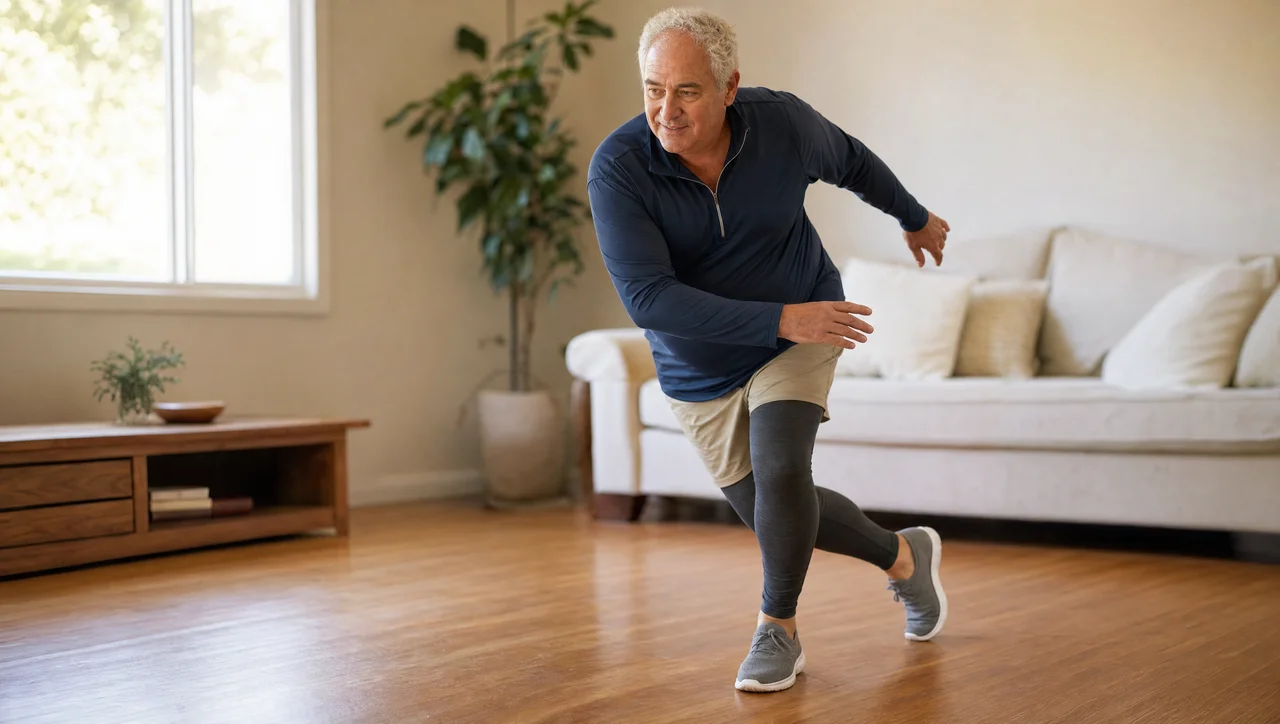
The finishing touch, and a clever one. This movement combines two of the essential ingredients for fracture prevention, balance and impact, in a single exercise. The side-to-side landing challenges those stabilising hip muscles, while each hop sends a ground reaction force up your legs, through your hips and into your spine, another order for the crew.
Setup:
- Clear some floor space and keep a sturdy surface within arm's reach.
- Wear supportive shoes, like a pair of running shoes.
How to do it:
- Start with a static ice skater hold, simply balancing on one leg.
- Progress to a small step or hop from side to side, landing softly each time.
- For a greater challenge, try full jumping ice skaters, covering more distance with each jump.
The Dose: 3 sets of 30 seconds, twice a week.
To adjust: hold the static balance or rest your fingertips on a bench to ease off, or jump further and higher as your confidence builds.
A reminder from our team"Challenging means each rep is genuinely difficult for you. It should never feel easy. If at the end of your set you think you could have easily continued, that's your sign to do a harder version or use a bit more weight. That's the intensity required to signal your bones to get stronger."
Brodie Morrison, 55+ Expert Physiotherapist, Be Mobile Physiotherapy
Prefer to train with a physio guiding the pace? Our free 55+ Video Series gives you complete follow-along workouts, with every movement demonstrated and modified for real bodies over 55.
Start the Free 55+ Video Series →Putting It All Together
Everything above fits into two short sessions a week, run from your living room. A workable rhythm looks like this:
- Schedule two sessions a week, with at least a day of rest between them.
- Run the strength work first: the squat, the RDL, and the step-up, each for 3 sets of 5 to 8 challenging reps.
- Finish with the ice skaters, 3 sets of 30 seconds, at whichever level of the progression suits you today.
- Apply the last-rep test each session. When a set starts feeling easy from start to finish, add a book or two to the backpack, and let the next-morning check guide how quickly you climb.
The beauty of this routine is that the impact work is already built in. Between the heavy muscle-on-bone pull of the strength exercises and the ground reaction force of the ice skaters, your hips receive both of the messages bone responds to.
The Bottom Line
Your hip bones are on a building site right now, crew on shift, waiting for instructions. Skip the work and the orders never arrive. Put these four movements into your week, and you're handing over exactly the kind of demand that bone is designed to answer.
Stronger hips mean more than a better scan result. They mean catching yourself when you stumble, gardening without second thoughts, and staying firmly in charge of your own two feet for years to come.
Start this week with bodyweight only, find the level that feels like honest work, and let the backpack get heavier as you do. Your hips are more buildable than you've been led to believe. 💪
Ready for guided workouts instead of going solo? Our free 55+ Video Series includes complete bone-safe strength sessions led by our physio team, so you can put all of this into practice with confidence from day one.
Get Started With the Free 55+ Video Series →