The Top 3 Bodyweight Chair Exercises for Over 55s (No Equipment Needed)

Mitch - Be Mobile Physiotherapy
Mitch is a physiotherapist with over 23 years’ experience helping adults aged 55+ exercise safely, including when they’re managing pain or chronic conditions. He is the Founder and CEO of Be Mobile Physiotherapy, a physio‑led exercise company offering online and in‑person programs that keep older adults strong, confident, and able to enjoy life with the people they love.
Read Mitch's full bio →


In this article, the Be Mobile Physiotherapy team walks through three simple bodyweight exercises that build genuine strength, all without a single piece of gym equipment. Just you, a sturdy chair, and a bit of floor space.
Most people walk past a chair without thinking twice. It's furniture. You sit on it. You eat dinner at it. You drag it over when you need to reach the top shelf. What you probably haven't done is treat it as a piece of gym equipment.
Maybe you've been meaning to get stronger but the idea of joining a gym feels like a stretch too far. Maybe a knee or hip niggle keeps you sceptical about anything called a "workout." Maybe you tried a YouTube routine designed for someone in their thirties and quietly closed the laptop after about four minutes.
Here's something worth knowing. The most underrated piece of strength-training kit in your house is the sturdy dining chair you've already got. Pair it with a patch of floor and your own bodyweight, and you've got everything you need to build real, useful strength at any age.
The three exercises in this article are our pick for the most effective bodyweight movements going for adults over 55, full stop. They also happen to be ideal for travel, since you don't need a single thing besides what's already in the room.
Let's get into it.
Why Bodyweight Doesn't Mean Easy
There's a bit of a problem with how chair and bodyweight exercises are marketed. Open YouTube, search "chair exercises for seniors," and you'll find a sea of videos that look more like polite arm-waving than actual training.
That's not what we're talking about here.
When a bodyweight exercise is programmed properly, your own body is the load. Done with proper form and a bit of tempo, that's plenty of resistance for most adults over 55.
A slow push-up against a chair is genuinely hard work. A deep lunge is genuinely hard work. A single-leg glute bridge is genuinely hard work.
Most people get this backwards. They assume that because there's no dumbbell in their hand, the workout must be a piece of cake. Then they actually try a set of slow push-ups against the back of a chair and discover their arms are shaking by rep eight.
That's how it should feel. Bodyweight exercises, done right, are real strength work.
The Connection You Probably Haven't Made
There's a reason these three exercises sit at the top of every Be Mobile physio's list for the over-55s, and it isn't accessibility. Every single one of them rehearses something you already do, several times a day, without thinking about it.
You use your arms to get yourself up off the floor. That's a push-up.
You step up onto a kerb or kneel down to get something off the ground. That's a lunge.
You drive your hips up to stand out of a deep, low chair. That's a glute bridge.
These aren't abstract gym movements. They're the muscle patterns your independence quietly depends on. Train them a few times a week and you're not just building strength. You're rehearsing the specific skills that decide whether you can keep doing your own life, your own way, into your sixties, seventies, eighties and beyond.
The clinical research backs this up. Lower body strength, specifically the ability to control your bodyweight and execute movements like standing from a chair or stepping onto a kerb, predicts long-term independence in adults over 65 better than almost anything else we can measure.
Is This Actually Enough?
Fair question, and one we get a lot.
If you're already walking every day, doing the occasional hike, maybe even lifting a few weights, you might be wondering whether three bodyweight exercises can really do much. The honest answer is: it depends on where you're starting from.
If you've been mostly sedentary, getting through three sets of these three exercises, three times a week, will absolutely make you stronger. We've seen people go from struggling to get off a low couch to managing it one-legged inside six weeks. The runway from "nothing" to "noticeably stronger" is shorter than most people think.
If you're already active, these three exercises won't replace your weights work, but they will plug some surprising gaps. Most people who walk a lot have legs that move well going forward but tend to be weak in lateral and single-leg movement patterns. Lunges expose that weakness very quickly.
Either way, the test is simple. Try them tonight. If you feel them tomorrow, the exercises are doing their job.
A reminder from our team"When clients tell me bodyweight exercises sound too easy, I ask them to do ten slow push-ups against a chair, lowering for three full seconds each rep. Many of them can't finish the set with their chest reaching their hands by rep seven. Bodyweight doesn't mean light. It just means the load is your own body, and for most of us, that's plenty."
Mitch, Founder & CEO, Be Mobile Physiotherapy
What to Watch Out For
A couple of quick safety points before we get to the exercises themselves.
First, the chair you use matters. You want a solid dining chair or a kitchen chair, ideally pushed against a wall so it can't slide. No wheels. No flimsy folding chairs. No soft armchairs either, since the cushions absorb the movement and ruin the exercise.
Second, the "start low, go slow" rule applies. If full push-ups are too hard, do them on your knees, or against a chair back, or against the kitchen bench. If a deep lunge feels shaky, hold the chair for balance and lower yourself only halfway. If the standard glute bridge feels easy, progress to a single-leg version.
Pick the version that lets you finish your set with good form and a bit of effort left in the tank. Build from there.
This guide is for educational purposes only and should not replace specific advice from a medical professional. If you've had a recent injury or surgery, or your doctor has cleared you for specific movements only, follow their advice first.
Prefer to follow along rather than work from a written guide? Our free 55+ Video Series walks you through these movements step by step, with our physio team demonstrating every variation and every cue, so you can pick the right version for you.
Watch the Free Video Series →The Top 3 Bodyweight Chair Exercises
1. The Push-Up
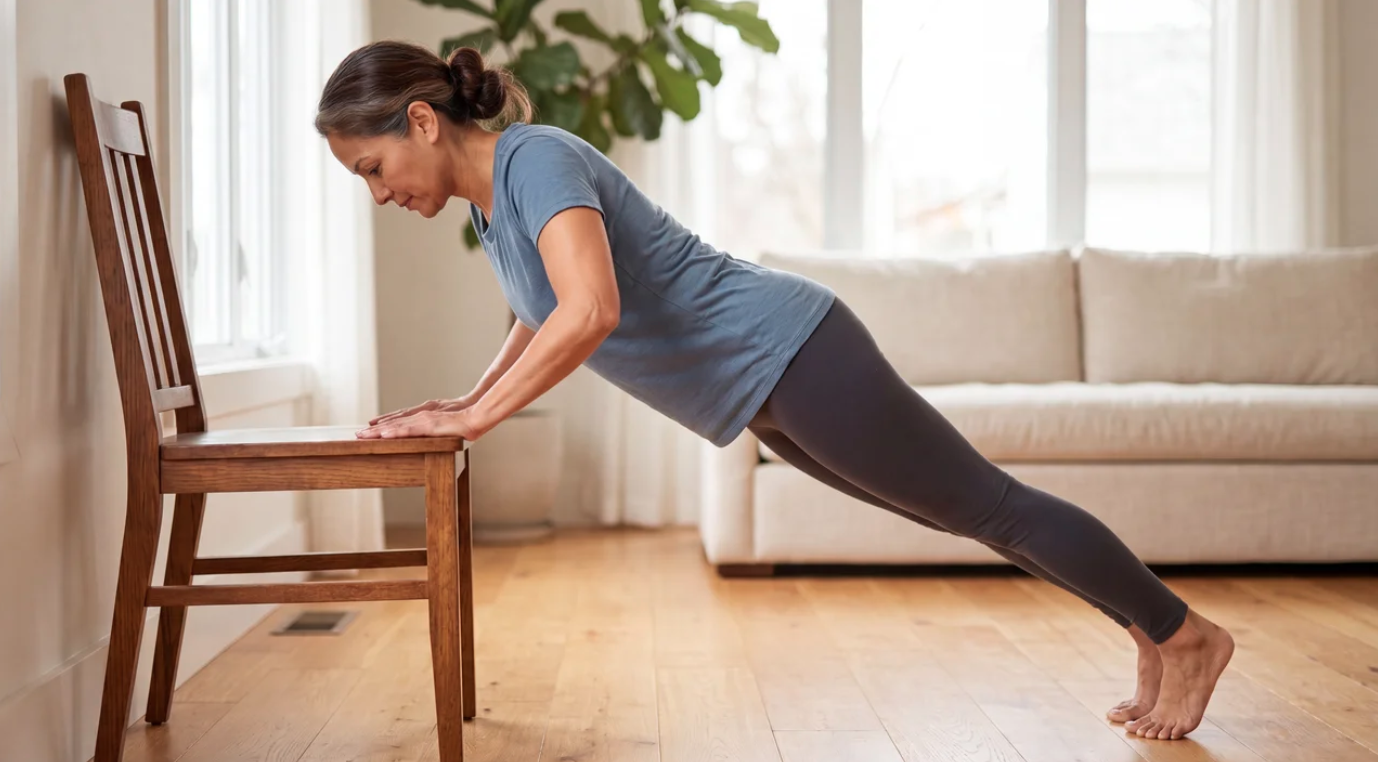
Our favourite, and for good reason. The push-up is the single most useful upper body bodyweight exercise going, and it scales from "I can just about do one against a chair" to "I can knock out twenty proper full ones" without changing the movement pattern.
It builds the chest, shoulders, and the back of the arms in the exact pattern you use to catch yourself if you stumble forward, push yourself up off the floor, or get out of bed in the morning.
How to do it (easiest variation first, work your way up):
- Easiest: Inclined push-up against a chair, bench, or couch. Place your hands on the back of a sturdy chair (pushed against a wall so it can't move), a low bench, or the arm of a couch. Walk your feet back so your body forms a straight line from head to heels. Lower your chest towards your hands with control, then push back up.
- Medium: Knee push-up on the floor. Kneel on the floor and walk your hands forward until your body forms a straight line from your knees through your hips and shoulders. Lower your chest towards the floor and push back up.
- Hardest: Full push-up. Same shape as the knee version, but on your toes instead, with your body in a straight line from heels to head.
The Dose: 3 sets of 8 to 15 reps. Pick the version where rep 8 starts to feel hard, with two or three reps left in the tank by the end of the set.
When that version becomes easy across all three sets at 15 reps, progress to the next one down. The lower your hands go, the harder the exercise gets.
2. The Lunge
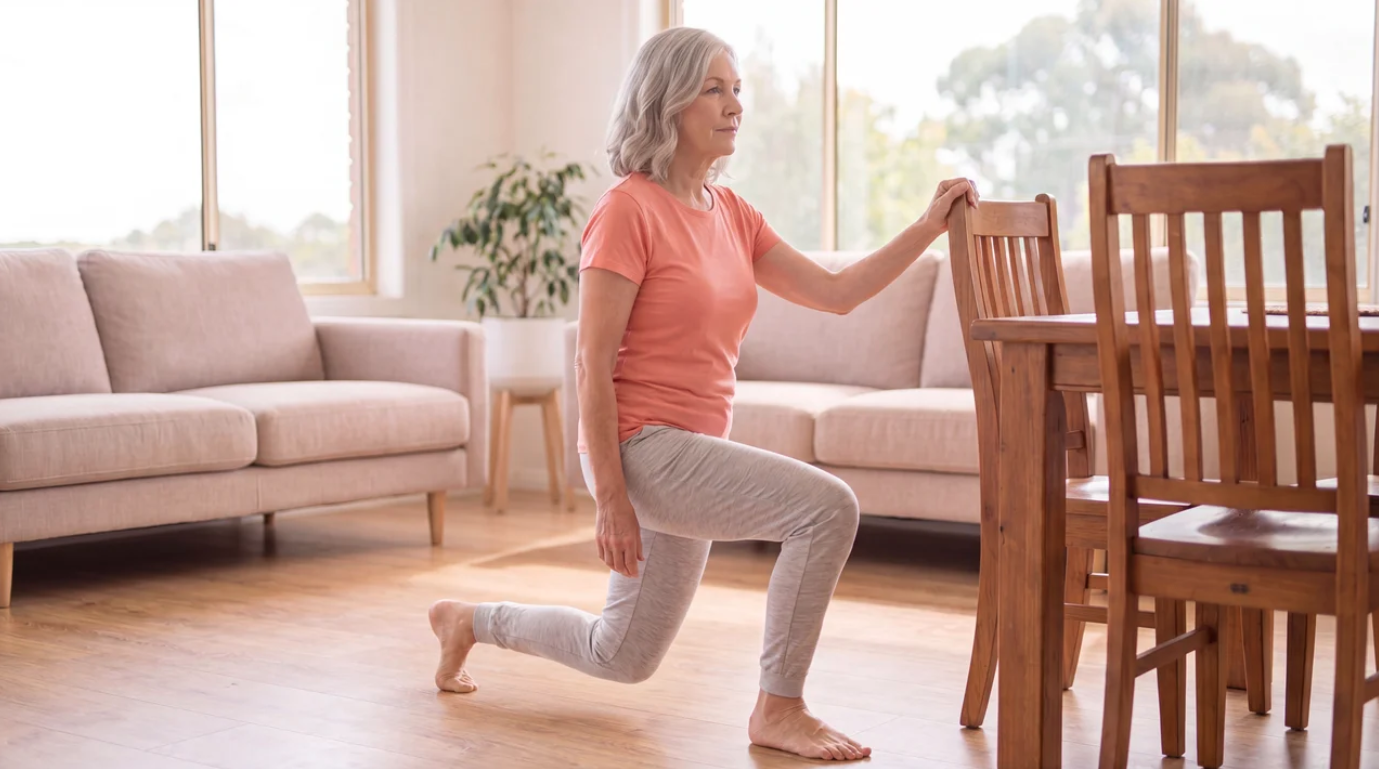
We rate the lunge as one of the best leg exercises in existence, and the reason is simple: it works one leg at a time. That matters more than people realise.
Most falls happen when you're single-legged, mid-step, with all your weight on one side. A two-legged squat or sit-to-stand trains the legs together. A lunge trains the exact pattern that falls expose. Step up onto a kerb, recover when you trip over the dog, walk down a set of steep stairs: it's all lunge mechanics.
How to do it:
- Stand tall with your feet hip-width apart. Hold onto the back of a chair or a kitchen bench for balance if you need it.
- Take a comfortable step forward with one leg. Not too short, which cramps you up, and not too long, which makes it hard to step back. About a normal stride length.
- Keeping most of your weight on your front leg, lower your back knee towards the floor.
- Push through the foot of your front leg to step back to the start.
- Repeat on the same leg for your set, then switch sides.
The Dose: 3 sets of 8 to 15 reps per leg.
Start with shallow lunges if you're new to it, and use the chair for support. As you get stronger, lower yourself deeper and let go of the chair. Eventually, you can progress to a full unsupported lunge with your back knee almost touching the floor.
3. The Glute Bridge (Hip Raise)
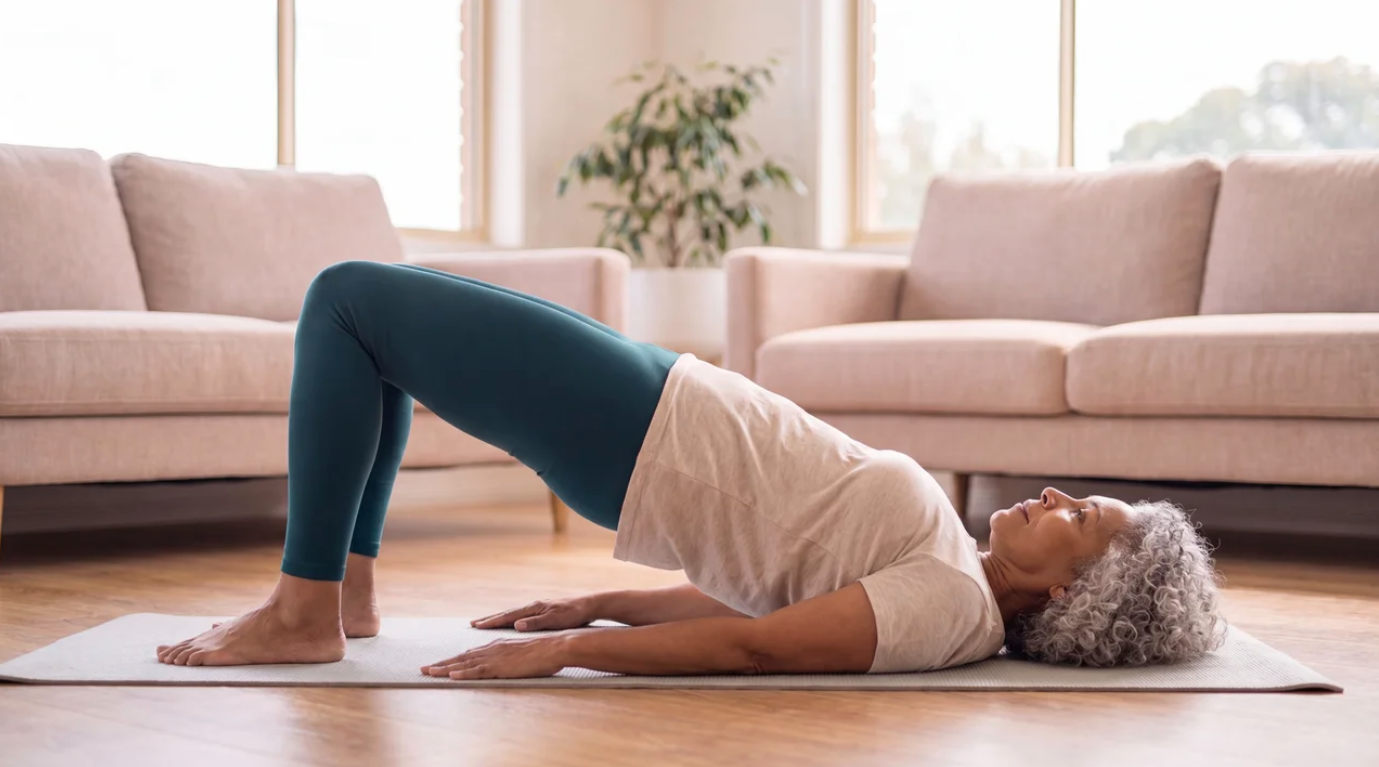
Completing the bodyweight trio is the glute bridge. While lunges focus on single-sided leg strength and push-ups take care of the upper body, the glute bridge focuses on the hamstrings and glutes, the back-of-the-body muscles that often get neglected.
Think of your glutes as the powerhouse of your hips. They provide the necessary drive to stand up from a low seat and the power to climb inclines.
How to do it (three versions, easiest to hardest):
- Standard: Lie on your back on the floor or a firm bed. Bend your knees and tuck your feet in close to your bottom, flat on the floor. Push through your heels to lift your hips up towards the ceiling. Squeeze your glutes at the top, then lower with control.
- Single-Leg: Same starting position, but lift one foot off the floor and hold it in the air. Drive your hips up using just the working leg. Do all your reps on one side, then switch.
- Elevated: Place your heels on the edge of a sturdy chair or low bed instead of the floor. The extra height increases the range of motion, which makes the exercise harder. Can be done with both legs or single-legged for an extra challenge.
The Dose: 3 sets of 8 to 15 reps. Start with the standard version. Once that feels easy at 15 reps, progress to single-leg, then to elevated.
The single-leg elevated version is genuinely difficult, and most people over 55 can't manage more than a handful first time. That's a good thing. It gives you somewhere to grow into.
Want a full follow-along session built around these three? If you'd like to get started alongside our physio team, with demonstrations, pacing and modifications built in, that is exactly what our free 55+ Video Series is for.
Start the Free 55+ Video Series →
A reminder from our team"If I had a dollar for every client who said 'these are too simple, I want the harder version,' then changed their mind by rep ten, I'd be a wealthy man. You often don't need to add weight or find a fancier exercise. The fix is to slow it down. Take three seconds to lower yourself, pause for a beat at the bottom, push back up. Same exercise. Twice as hard."
Mitch, Founder & CEO, Be Mobile Physiotherapy
Putting It All Together
A simple way to use these three exercises, two to three times per week (start at the variation you can manage):
- 3 sets of 8 to 15 Push-Ups
- 3 sets of 8 to 15 Lunges per leg
- 3 sets of 8 to 15 Glute Bridges
Rest about a minute between sets, longer if you need to. Aim to finish each set with two or three reps still in the tank.
A tip worth holding onto: when the exercises start feeling easy and you don't have any weights to add, two simple levers ramp up the intensity. You can do more reps per set, or you can slow each rep down so you spend longer under tension.
A three-second lower on a push-up is very different to a fast one. Same exercise, much harder work.
When you've progressed as far as more reps and slower speed will take you, move to harder variations. Knee push-ups become full push-ups. Supported lunges become unsupported and deeper. Standard glute bridges become single-leg or feet-elevated.
That's it. Three exercises. No equipment beyond a sturdy chair and a patch of floor. About fifteen to twenty minutes, two or three times a week.
It looks deceptively simple on paper. Done consistently for a few months, it builds real, useful strength in the exact patterns your independence relies on. Take this routine on holiday with you and you'll never miss a session because the gym was closed.
A reminder from our team"I tell clients to think of these three exercises as deposits they're making into the independence account. Each session, small deposit. Over months and years, that account is the difference between needing help and not needing help. The compounding is real. You just don't always see it day to day."
Mitch, Founder & CEO, Be Mobile Physiotherapy
The Bottom Line
It's easy to dismiss bodyweight exercises. They look gentle. They sound modest. The thing is, pushing, stepping and hip-driving make up most of what your body does on a normal day, and these three exercises rehearse all of it.
You don't need a gym membership. You don't need a personal trainer. You don't need to wait until you're "ready." You need a chair, a patch of floor, fifteen minutes, and the willingness to do something a couple of times a week.
Try it tonight. See how you feel tomorrow. 💪
Ready to get started? Our free 55+ Video Series includes full follow-along workouts designed by our physiotherapy team, so you can build confidence and strength right from your living room.
Get the Free 55+ Video Series →