The Best Bodyweight Exercises for Over 55s (No Equipment Needed)

Ollie - Be Mobile Physiotherapy
Ollie is a physiotherapist at Be Mobile, passionate about changing society's misconception that older adults shouldn't lift weights. He writes most of our articles on strength, balance and confidence for the 55+ community.
Read Ollie's full bio →


A practical guide from the Be Mobile Physiotherapy team for anyone who wants to keep building real strength at home, on holiday, or anywhere else life takes them.
So you've finally got a bit of a routine going at home. Maybe you've got some dumbbells in the corner and a resistance band you actually use, and for the first time in a while, you're starting to feel a bit stronger.
Then you go away for a week. Could be the caravan, staying with the grandkids, or a hotel somewhere new. Within about a day of being there, the thought sneaks in: "well, that's my exercise on hold until I get home."
Here's what we want you to know before you read another word. You don't actually need any of that gear. You can get a great workout in with just your bodyweight.
When people over 55 picture "strength training," they usually picture a gym. Dumbbells, kettlebells, cable machines, and someone in a branded T-shirt grunting under a barbell.
Because of that mental picture, loads of people assume that if their equipment isn't there, their strength work has to wait.
But your muscles don't care where the effort is coming from. They only care about how hard they're being asked to work. A push-up is real strength training, and so is a lunge, and so is a glute bridge. None of those need a single piece of kit, and all of them, done consistently, build proper functional strength.
Why Three Exercises Is Plenty
Muscles respond to challenge. Ask them to do something difficult and they adapt a little: a bit stronger, a bit more efficient, a bit better at the job you're giving them. Where the challenge comes from makes very little difference. Your own body is, in fact, a surprisingly capable piece of gym equipment. Lifting yourself through the right movements can be as demanding as lifting a dumbbell.
Here's what a steady bodyweight routine can actually do for you:
- Build real strength across your chest, shoulders, back and arms
- Load your legs and glutes in the same basic ways squats and lunges do with weight
- Keep your training ticking over through holidays, disrupted weeks, and busy patches of life
- Remove the "I haven't got my gear with me" excuse for good
That last one is a bigger deal than it sounds. For adults over 55, consistency matters a lot more than how hard any one workout is. A routine you can run in a hotel room or a holiday house is a routine you'll actually stick with.
A reminder from our team"In clinic, the patients making the most progress aren't always the ones with the fanciest home setups. They're the ones who just keep going, no matter where they are. If your workout fits inside a suitcase, you don't really get to talk yourself out of it."
— Oliver Halliday, 55+ Expert Physiotherapist, Be Mobile Physiotherapy
"But is that really enough?"
We get it. It almost sounds too simple. Three exercises, nothing fancy, and that will do?
Being honest with you: a full gym program with a progressive barbell will build more top-end strength than bodyweight on its own. That part is true. For most adults over 55, though, top-end strength isn't really the goal. The goal is being strong enough, capable enough, and confident enough to do the things that actually matter in daily life. Getting up off the floor without a struggle. Carrying the shopping in from the car. Climbing a flight of stairs without having to stop halfway. Scooping up a grandchild without a second thought.
For any of that, three well-chosen bodyweight exercises, two or three times a week, will do the job. Because there's room to keep making them harder over time, with harder variations, more reps, or slower tempos, most people will never actually run out of room to progress.
A quick word on safety, framed the way our team tends to frame it: risk vs reward.
What's the risk of not doing this? Skipping sessions every time you're away from your gear, losing momentum, and watching weeks of progress slowly come undone because a trip got in the way.
What's the risk of doing it? Pretty low. You're in full control of the intensity at every moment. Push-ups feeling too hard? Back to a higher surface. Lunges a bit much? Shorten them and grab a chair for balance.
In a nutshell: start low, go slow. Pick the easiest version of each movement, get comfortable there, and only then start progressing.
One note before we carry on. This article is for general education and doesn't replace specific medical advice. If your doctor has given you particular restrictions, please follow their advice first.
Want to follow along instead of working from a written guide? Our free 55+ Video Series walks you through an at-home workout step by step, with our physio team demonstrating every move, every modification, every cue — so you can pick the right version for you.
Watch the Free Video Series →The Three Exercises
1. Push-ups
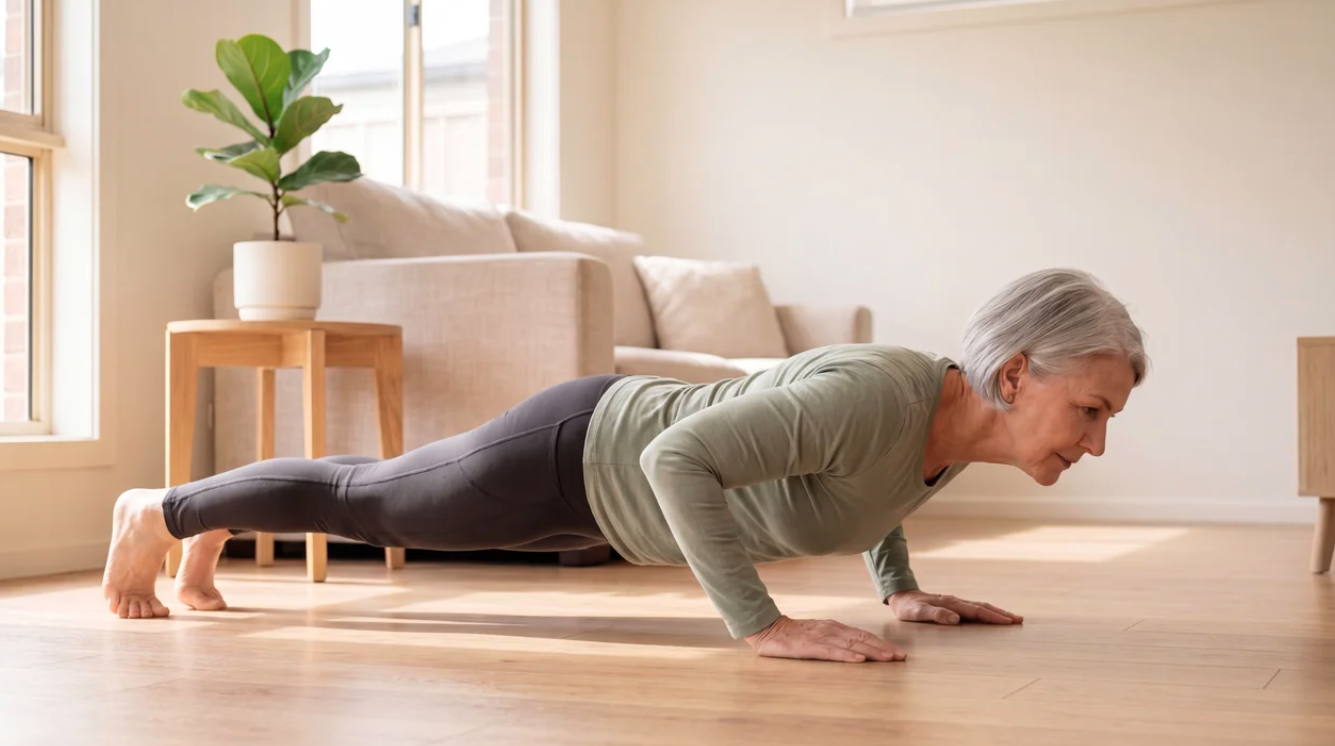
Push-ups are one of our team's favourite upper-body exercises done without equipment. They train your chest, shoulders, triceps and core in one movement. On top of that, they're one of the best rehearsals you can do for the skill of getting up off the floor safely. Being able to push yourself up off the ground is one of the clearest markers of staying independent as you get older.
The other nice thing about push-ups is that there's a clear progression ladder, so everyone can find a version that works right now.
How to do it, starting with the easiest:
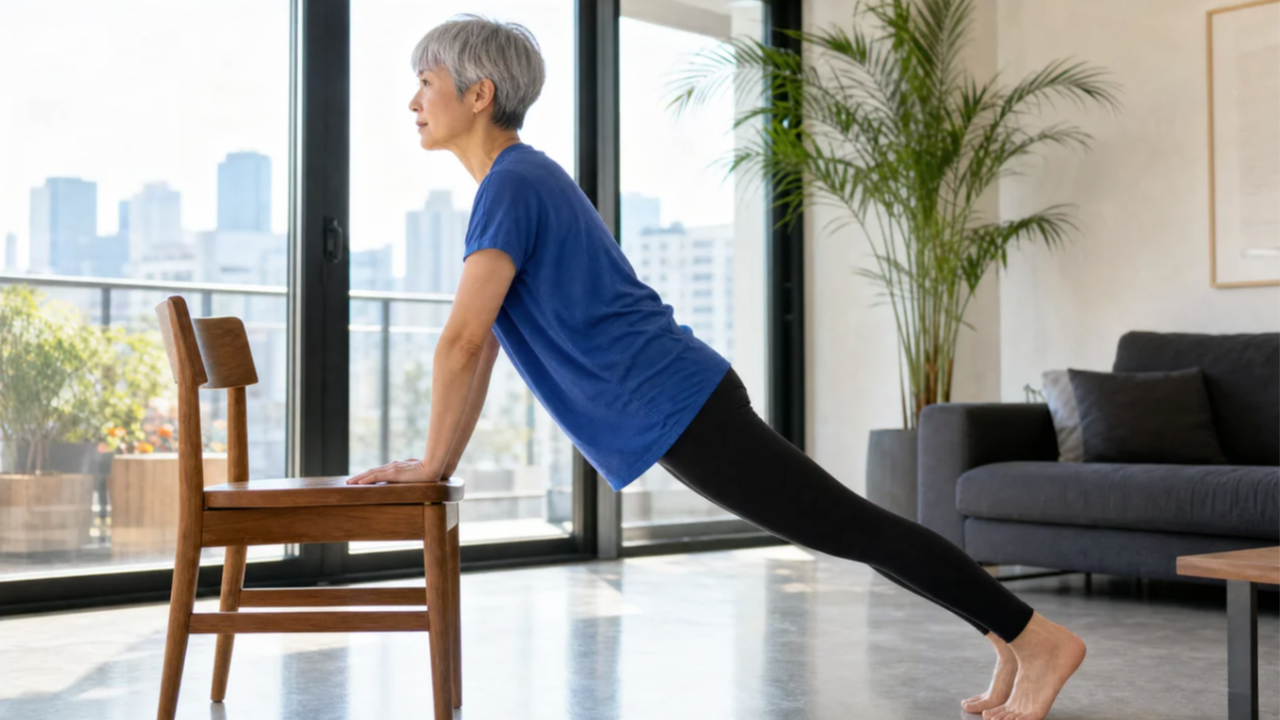
- Against the back of a sturdy chair or a kitchen bench. Stand about an arm's length away, place your hands on the top, and lower your chest in before pressing back up.
- On the seat of the chair. Same movement, but your body is now at a steeper angle, which makes it noticeably harder.
- On your knees on the floor. Come down onto your knees with your hands on the floor, and lower your chest towards the ground with control.
- Full push-ups from your toes. The classic version, once you're ready for it.
Aim for whichever version makes the final couple of reps feel genuinely tough. When those reps start to feel easy, step up to the next level.
The Dose: 3 sets of 8 to 15 reps.
2. Lunges
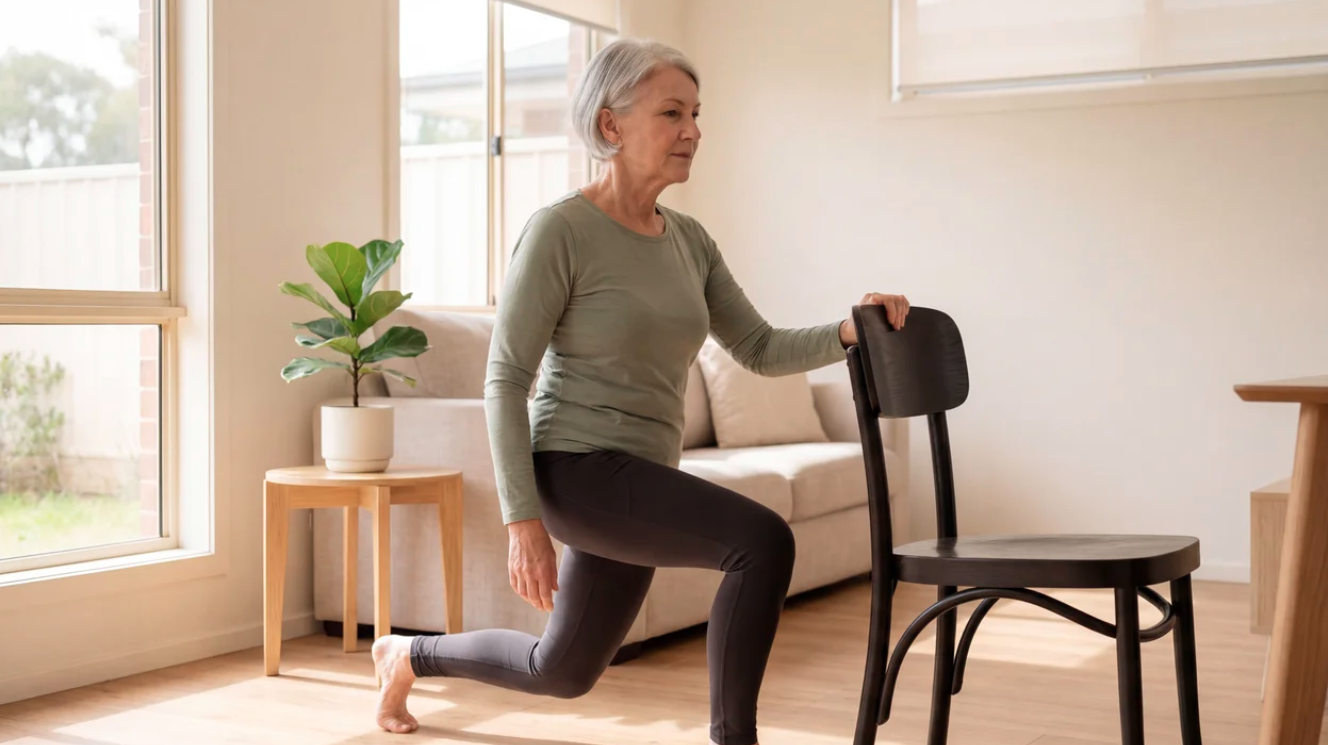
Lunges are one of the best leg exercises going, and for a pretty simple reason: they make each leg work on its own. Both sides get tested honestly and you can't really hide behind the stronger one. That single-leg loading is exactly what your legs need to stay strong for stairs, hills, and stepping up into a caravan or onto a high curb.
How to do it:
- Stand tall with your feet together, and keep a sturdy chair nearby for balance if you need it.
- Take a natural-feeling step forward with one leg. Not too short, not too long. Somewhere you can keep your balance without effort.
- Lower your back knee down towards the floor, keeping your front shin roughly vertical.
- Drive through your front foot to come back up to standing.
- Do all your reps on one side before you swap.
Easier: hold the chair, and only lower partway down.
Harder: bring your back knee closer to the floor, or hold a weight at your chest (a heavy book or a bag of rice does the trick).
The Dose: 3 sets of 8 to 15 reps per leg.
3. Glute Bridges
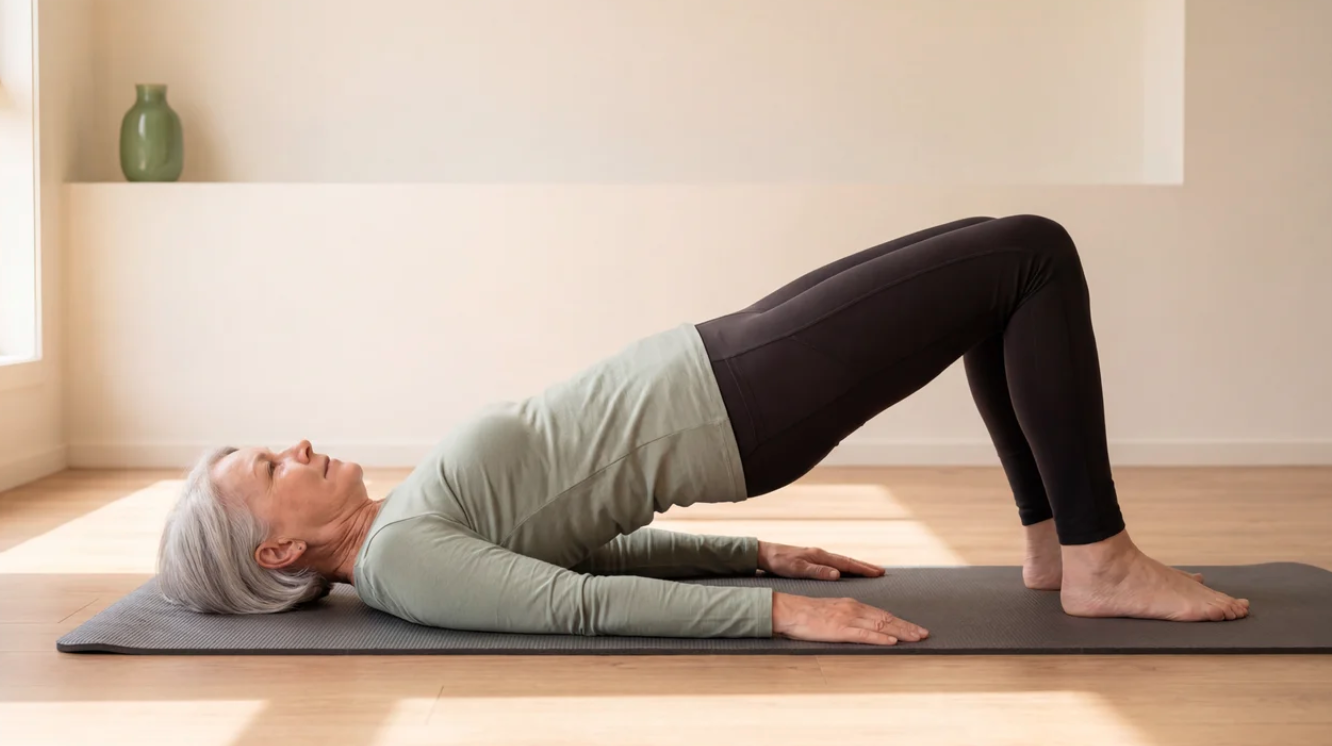
Glute bridges are a great exercise for building strength and muscle in your buttocks. Because they don't load the knees, they are a great starting point for those with knee pain.
How to do it:
- Lie on your back on the floor, a mat, or a firm bed.
- Bend your knees and bring your feet in towards your bottom.
- Squeeze your glutes and lift your hips up, stopping when your body forms a straight line from shoulders to knees.
- Hold there for a moment.
- Lower back down with control.
Harder: try a single-leg version, with one foot on the floor and the other leg held straight out in front. Or, if you want more range of motion, elevate your feet up on the edge of a sturdy chair or firm bed.
The Dose: 3 sets of 8 to 15 reps.
If you'd like to get started with a guided, follow-along routine you can do alongside our physio team — with full demonstrations, pacing and modifications built in — that's exactly what our free 55+ Video Series is for.
Start the Free 55+ Video Series →How to Keep Progressing Without Adding Weight
This is probably the most important bit, because without dumbbells or weights to reach for, your progression has to come from somewhere else. Three levers do most of the work here:
- Move up a variation. The push-up ladder is the clearest example, but every exercise here has a harder version waiting for you.
- Add reps. Once 8 to 15 reps has started to feel comfortable, push towards the top end of that range and then past it.
- Slow the tempo. This one is underrated. Take three or four seconds to lower into each push-up, or to drop into each lunge. That controlled, slow lowering piles on a huge amount of extra demand without changing anything else about the exercise.
Mix and match these three as the weeks go by, and bodyweight training will carry on challenging you for a very long time.
A reminder from our team"The mistake we see most often with bodyweight work is people sticking with the same variation, the same reps and the same tempo, forever. You wouldn't use the same pair of dumbbells for five years without going heavier at some point, and the same logic applies here. Push the exercise on, slow it down, or go for more reps. Your body needs that challenge to keep responding."
— Oliver Halliday, 55+ Expert Physiotherapist, Be Mobile Physiotherapy
Putting It All Together
You can run the whole routine from any living room, hotel room, holiday rental or caravan. A floor and a sturdy chair is the entire kit list.
Aim for two or three sessions a week. A full session looks something like this:
- 3 sets of 8 to 15 push-ups, at whatever variation is challenging you today
- 3 sets of 8 to 15 lunges per leg
- 3 sets of 8 to 15 glute bridges
For each exercise, the rule of thumb is the same. Pick a variation where the final couple of reps feel honestly tough. If they don't, that's your cue to progress: harder variation, more reps, or slower tempo, take your pick.
Keep this going for three to six months and the research is pretty consistent about what happens. A stronger upper body, stronger legs and the nice quiet knowledge that your routine comes with you wherever you go.
The Bottom Line
The idea that you need a gym, a set of dumbbells, or an expensive piece of kit to build real strength after 55 is one of the more common (and more unhelpful) myths we come across in online clients.
It's much simpler than that. Your muscles respond to effort, and they're not particular about where the effort is coming from. Three exercises, a floor, a chair, a couple of sessions a week. That isn't a compromise routine for when you're away from home. It's a proper strength program in its own right, and the fact that it travels with you is almost a bonus.
Start with the version you can manage today. Add a little next week. Your body will come along for the ride.
Ready to give it a proper go? Our free 55+ Video Series includes a full follow-along workout designed for adults over 55, guided by our physio team, so you can build real strength safely from day one — at home, on the road, or anywhere else.
Get the Free 55+ Video Series →