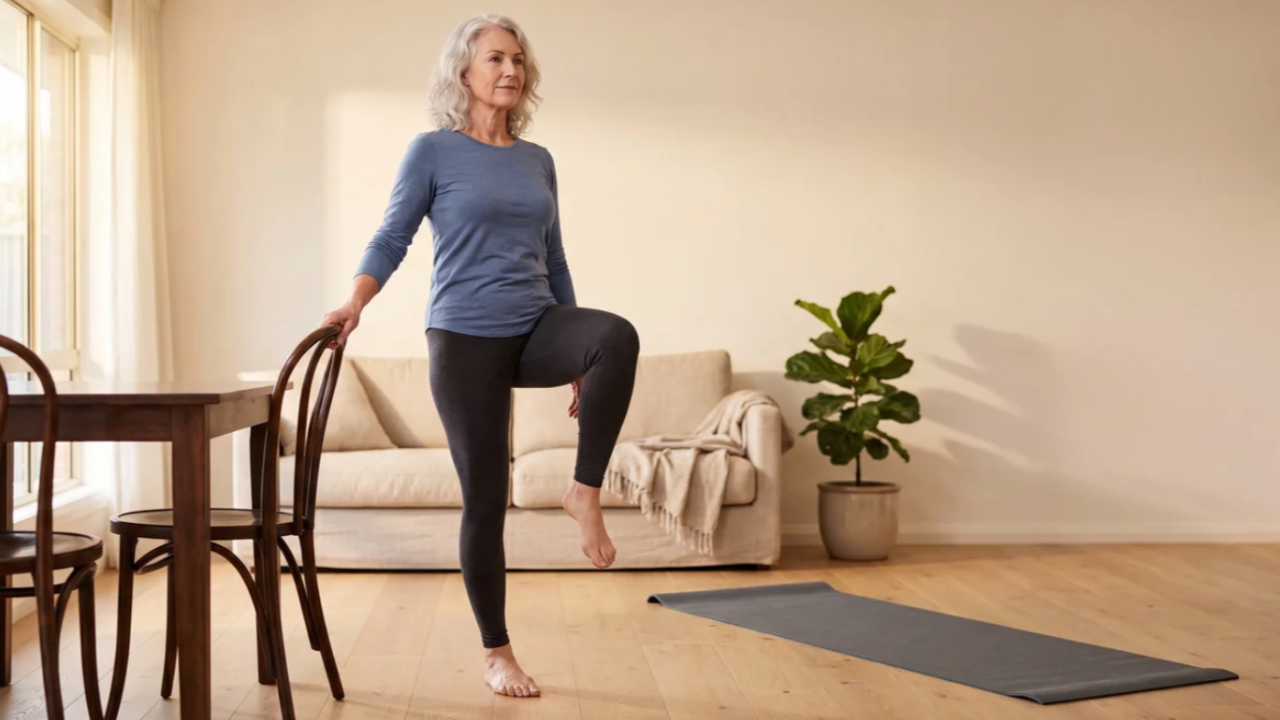
The Best Knee and Hip Exercises for Over 55s to Boost Leg Strength Safely

Brodie - Be Mobile Physiotherapy
Brodie is a physiotherapist at Be Mobile whose passion for exercise started early - an active, sporty childhood, and a knee injury playing high-school rugby that put him through a heap of physio and inspired him to study it himself. He truly embodies our value of evidence-based practice and is passionate about exercise for older adults. Outside of work, you'll find him with friends, at the rugby, or reading up on sci-fi, cosmology and physics.
Read Brodie's full bio →


In this article, the Be Mobile Physiotherapy team walks through five simple, effective exercises for stronger knees, stronger hips, and more confident legs. We'll also explain exactly why leg strength is one of the best things you can do for joint pain, balance, and keeping your independence as you get older.
So your knees twinge on the stairs. Or your hips feel stiff when you stand up from the chair. A small niggle that wasn't there a year ago has slowly become a daily companion.
Maybe you've started skipping the walk you used to enjoy. Maybe a well-meaning friend has told you it's "just wear and tear," and part of you has quietly accepted that this is how things are going to be from now on.
Here's what we want you to know straight away: your knees and hips aren't wearing out. They're asking to be used, a bit differently than they used to be.
Let's break it down. First, an important distinction.
When a joint starts to hurt, the instinct is often to protect it. Move it less. Avoid the stairs. Sit down more often. It's completely understandable. It's also not the best strategy.
You see, the pain you're feeling, in most cases, isn't coming from the joint itself being "damaged." Far more often, the pain comes from the fact that the joint is struggling to cope with the current demands you're placing upon it. In other words, it's a load vs capacity issue. The loads of everyday life are exceeding the joint's capacity to comfortably tolerate them.
Whilst reducing the loads (by resting the joint and moving less) can temporarily reduce the pain, it isn't a viable long term solution. Living a full and meaningful life requires you to place loads on your hips and knees by standing up from a chair, walking up a flight of stairs, or getting down on the ground to play with your grandkids (and getting back up again).
So if the issue is load vs capacity, and reducing the load isn't viable, we are left with one clear option. Increase the joint's capacity.
The only way to do this is through exercise, which builds the strength of the muscles around the joint and makes the joint itself adapt to be better at withstanding load.
Strength training is the key, and it's backed by a mountain of research.
Why Strength Training?
Your knee and hip joints aren't floating in isolation. They sit inside a working system of muscles. Your quads. Your glutes. Your calves. Your hamstrings. Each of them has a crucial job to do.
They work like shock absorbers.
With every step you take, every stair you climb, every sit-to-stand you perform, those muscles fire and absorb the load. When they're strong, the whole system is happy and you move through daily life with ease. When they're weak, even simple daily tasks become a struggle.
Done consistently, strength training can:
- ⬆️ Build the muscle mass and strength around your knees and hips.
- ⬆️ Increase the joint's load-bearing capacity.
- ⬆️ Improve balance and reduce the risk of falls.
- ⬇️ Reduce day-to-day stiffness and pain.
- ⬆️ Restore confidence with stairs, slopes, and getting out of low chairs.
Not all activity sends this signal equally. Walking? Lovely for cardiovascular health and mood, but not quite enough to meaningfully build leg strength on its own. Cycling? Gentle on the joints, though the load is too low to really challenge the muscles.
Strength training is where the real stimulus comes from.
A reminder from our team"One thing I wish every new patient with knee or hip pain who came into the clinic understood is the ‘load vs. capacity’ concept. Often they believe their pain is simply because their joint is ‘worn out’. That belief doesn't leave much room for hope. In reality, they have so much potential to improve. They need to work their joint harder, not rest it. Strength training will make the muscles stronger, the joint more resilient, and give the patient their life back."
Brodie Morrison, 55+ Expert Physiotherapist, Be Mobile Physiotherapy
But Is This Safe?
We get it. Hearing "strength training" when you're already dealing with knee or hip pain can sound like a recipe for making things worse. It's only natural to wonder whether this is safe.
It's hard to give a simple yes or no answer to whether any exercise is truly "safe." All movement carries some risk, just as sitting in a chair all day carries very real risks of its own.
We prefer to take a measured risk vs reward view, and honestly evaluate what's at stake in each scenario. Ask yourself:
What is the risk of NOT doing this? Progressive muscle loss, weaker legs, worsening joint pain, poorer balance, a higher risk of falls, and a steady decline in the everyday abilities that keep you independent.
What is the risk of DOING this? Very low, provided you start at a manageable level and build up gradually. The major studies looking at strength training for older adults with knee and hip pain consistently show reduced pain, better function, and minimal injury.
You might also assume that the key to avoiding injury is nailing "perfect technique." The very idea of perfect technique is vague, arbitrary, and not really backed up by evidence. Everybody is different. Every body moves differently. There is no single perfect technique that works for everyone.
The best way to reduce injury risk is actually very simple. Start with a variation and a level you can comfortably manage, and progress gradually from there.
In a nutshell, the key is one of our favourite mottos: "Start low, go slow."
You don't have to begin with a heavy barbell. You can begin with your own bodyweight, or a chair for support, or a small step. You build strength at a pace your body can keep up with. Week by week, the progress stacks.
It's also worth saying: hurt does not always equal harm. A small niggle during a new exercise is normal, especially in the early stages. It doesn't automatically mean damage is being done.
So when it comes to knee and hip pain, the rewards of gradual, progressive strength training clearly outweigh the risks.
This guide is for educational purposes only and shouldn't replace specific advice from a medical professional. If your doctor has given you particular restrictions, please follow their advice first.
Want to follow along instead of working from a written guide? Our free 55+ Video Series walks you through a full knee and hip strength session step by step, with our physio team demonstrating every move, every modification and every cue, so you can pick the right version for you.
Watch the Free Video Series →The Best Knee and Hip Exercises for Over 55s
1. Heel Raises
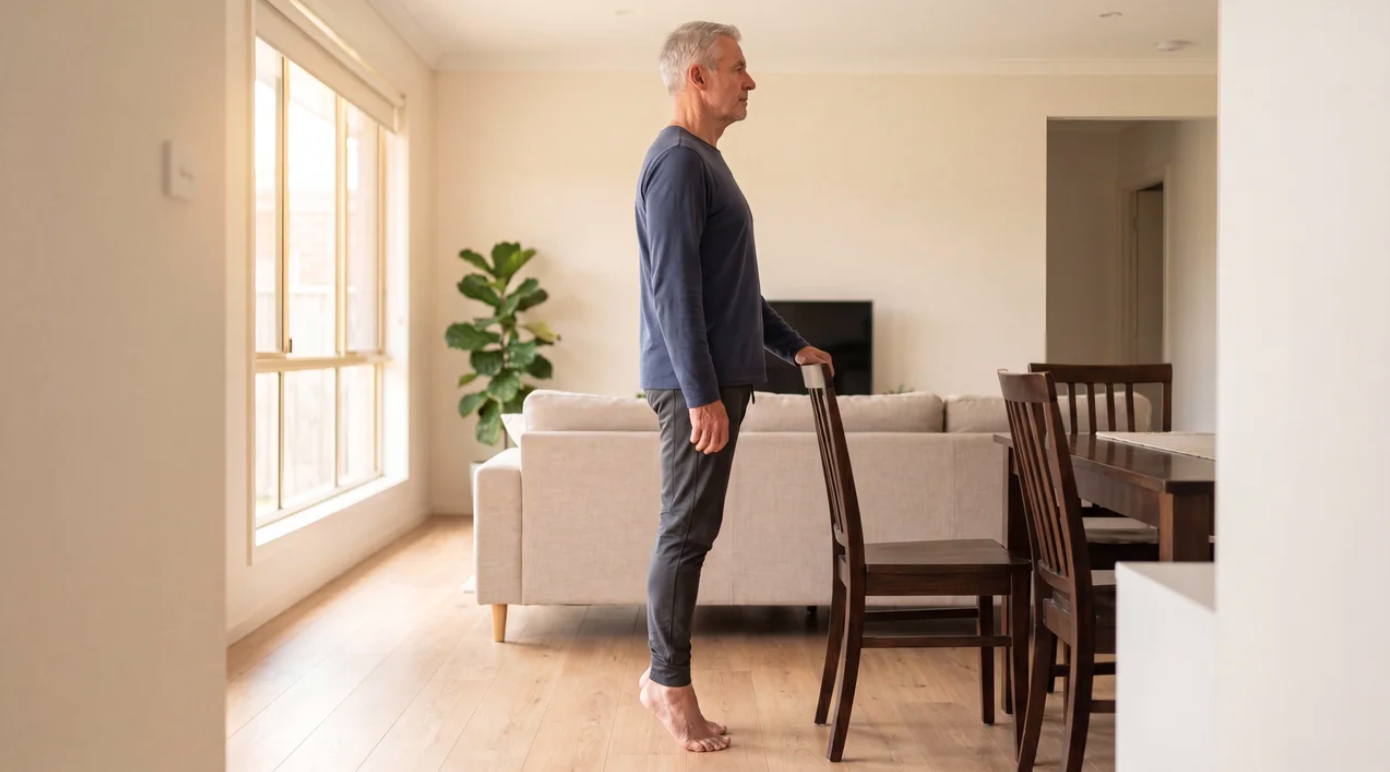
If there's one exercise that quietly underpins almost everything you do on your feet, it's the heel raise. Your calves are essential for walking, stair-climbing, and hiking. They also tend to weaken faster than almost any other muscle group as we age.
Strong calves mean better balance and more confidence on uneven ground. A double win.
How to do it:
- Stand tall behind a sturdy chair or kitchen bench, holding on lightly for balance if needed.
- Rise up onto the balls of your feet, lifting your heels as high as you can.
- Pause at the top.
- Lower back down slowly, with control.
- Progression: once two-legged heel raises feel easy, try one leg at a time.
The Dose: 3 sets of 8 to 15 reps.
2. Sit-to-Stand
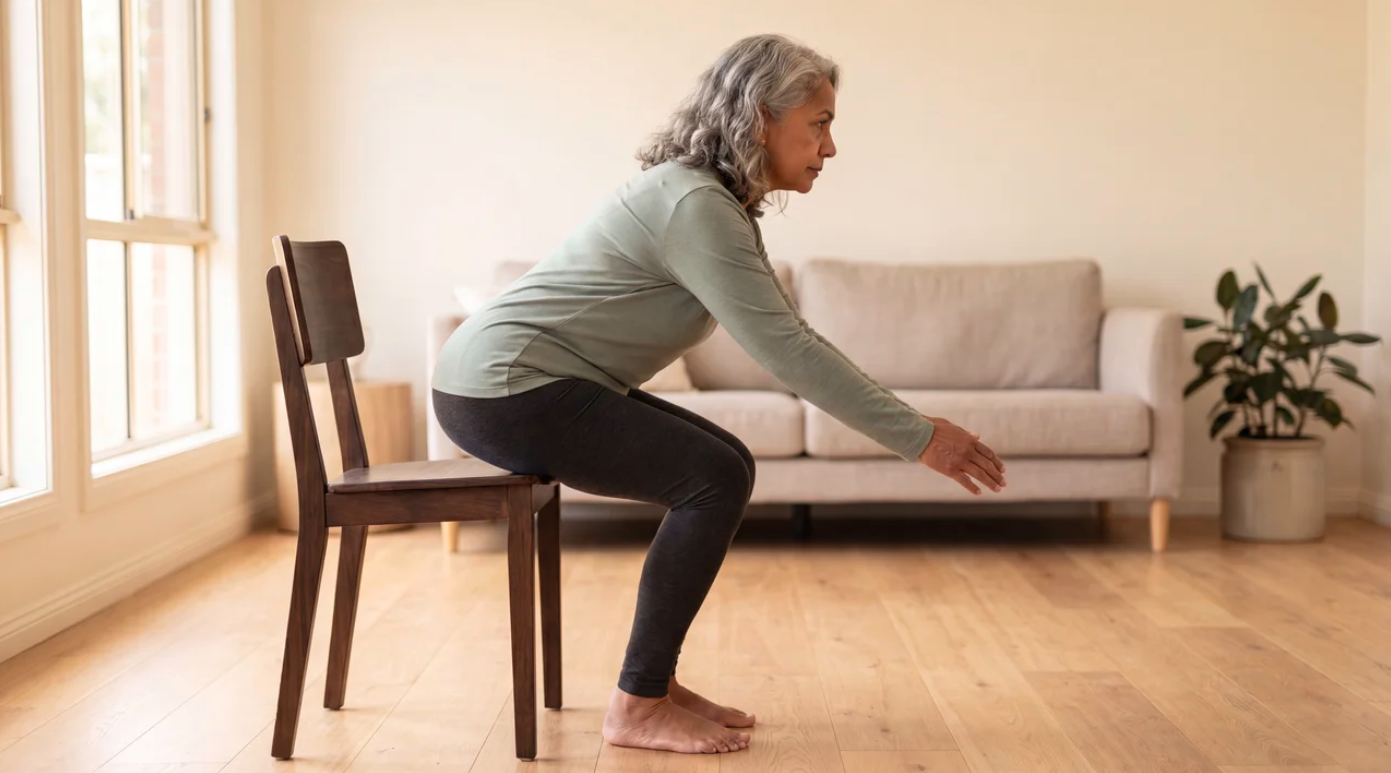
If we could only pick one exercise from this article for every over-55s routine, the sit-to-stand would be it. It's essentially a squat in disguise, a bit easier on the knees than a traditional squat, while still loading the quads and glutes beautifully. It often makes a great starting level for those with knee or hip pain.
How to do it:
- Sit on a sturdy chair.
- Lean forward so your nose is over your toes.
- Push through your legs to stand up tall.
- Lower back down slowly, with control.
- To make it easier: stack a cushion or two on the chair to reduce how far you have to sit down.
- To make it harder: hold a weight at your chest, such as a dumbbell, a kettlebell, or even a bag loaded with books.
The Dose: 3 sets of 8 to 15 reps.
3. Glute Bridge
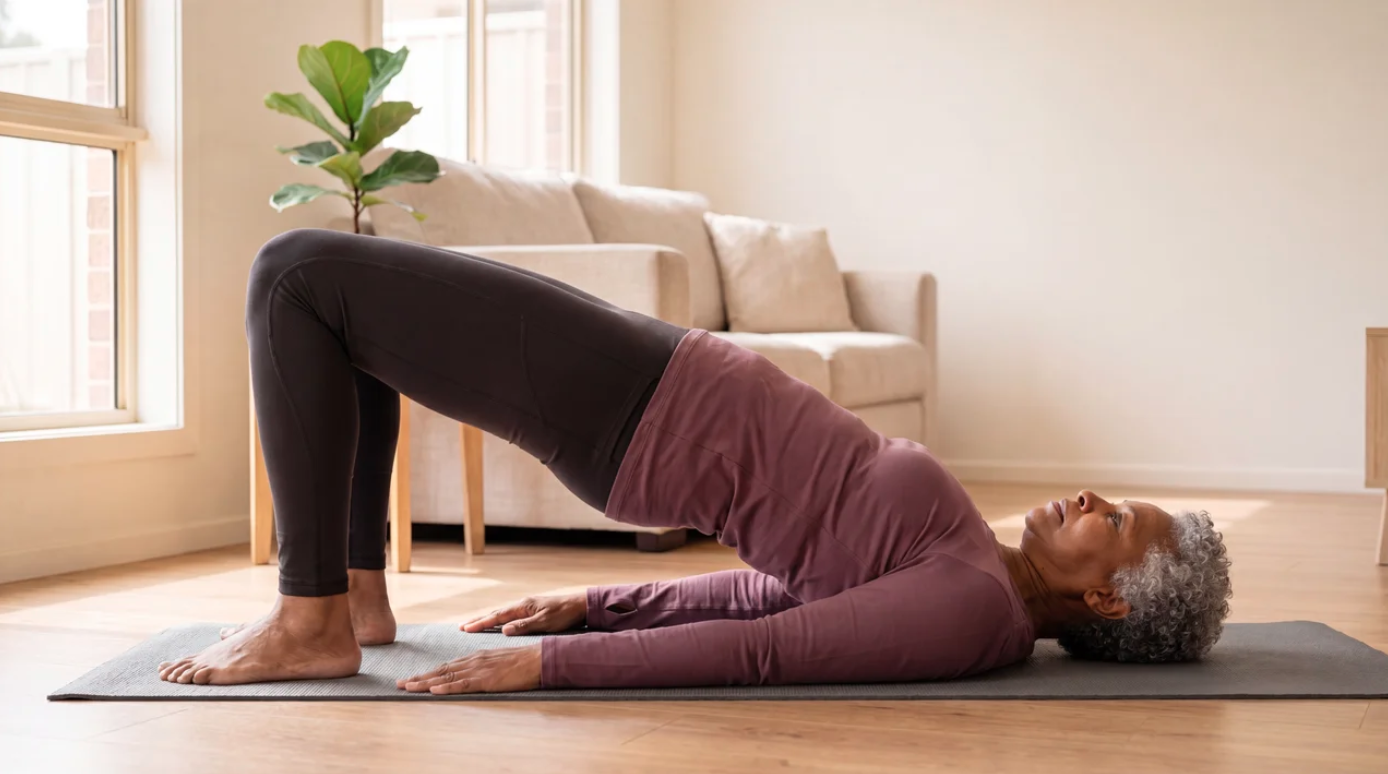
The glutes are another key muscle group for both hip and knee function. Strong glutes mean strong hips. They make squatting, walking and climbing stairs a breeze. Hence the glute bridge is a go-to exercise.
It's not much load on the hips or knees, which makes it a great starting point. As we said earlier, load isn't always a bad thing, and we don't want to avoid it entirely. Starting at a manageable level when you're in pain is essential though, and this is a great way to do that.
How to do it:
- Lie on your back on the floor, a mat, or a firm bed.
- Bend your knees and tuck your feet in towards your bottom.
- Push through your heels to drive your hips up towards the ceiling, until your body forms a straight line from shoulders to knees.
- Hold for a moment at the top.
- Lower back down with control.
- Progression: once that feels easy, try a single-leg version with one foot on the floor and the other leg lifted straight out in front.
The Dose: 3 sets of 8 to 15 reps.
4. Step-Ups
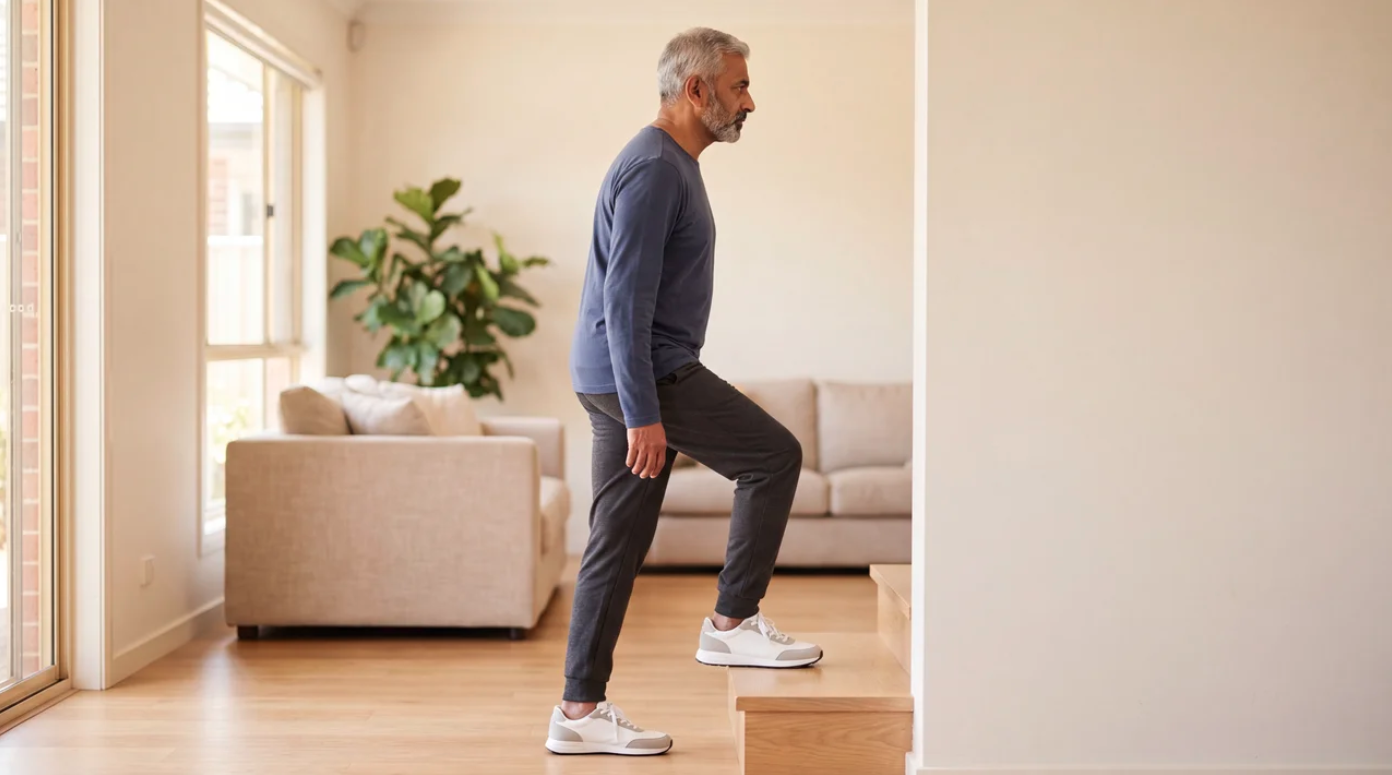
Stairs are one of the most common pain points for over-55s. Step-ups are the single best way to train for them. Because you're working one leg at a time, each leg has to do its own share of the load. No hiding behind the stronger side.
How to do it:
- Stand in front of a step or low platform. The bottom stair in your house works perfectly.
- Hold on for balance if needed.
- Place one foot fully on the step.
- Drive up through that foot until you're standing tall on the step.
- Step back down with control, leading with the same leg.
- Complete all reps on one side, then swap.
- To make it easier: use a lower step, or hold onto a handrail.
- To make it harder: use a taller step, or hold a weight.
The Dose: 3 sets of 8 to 15 reps per leg.
5. Wall Sits
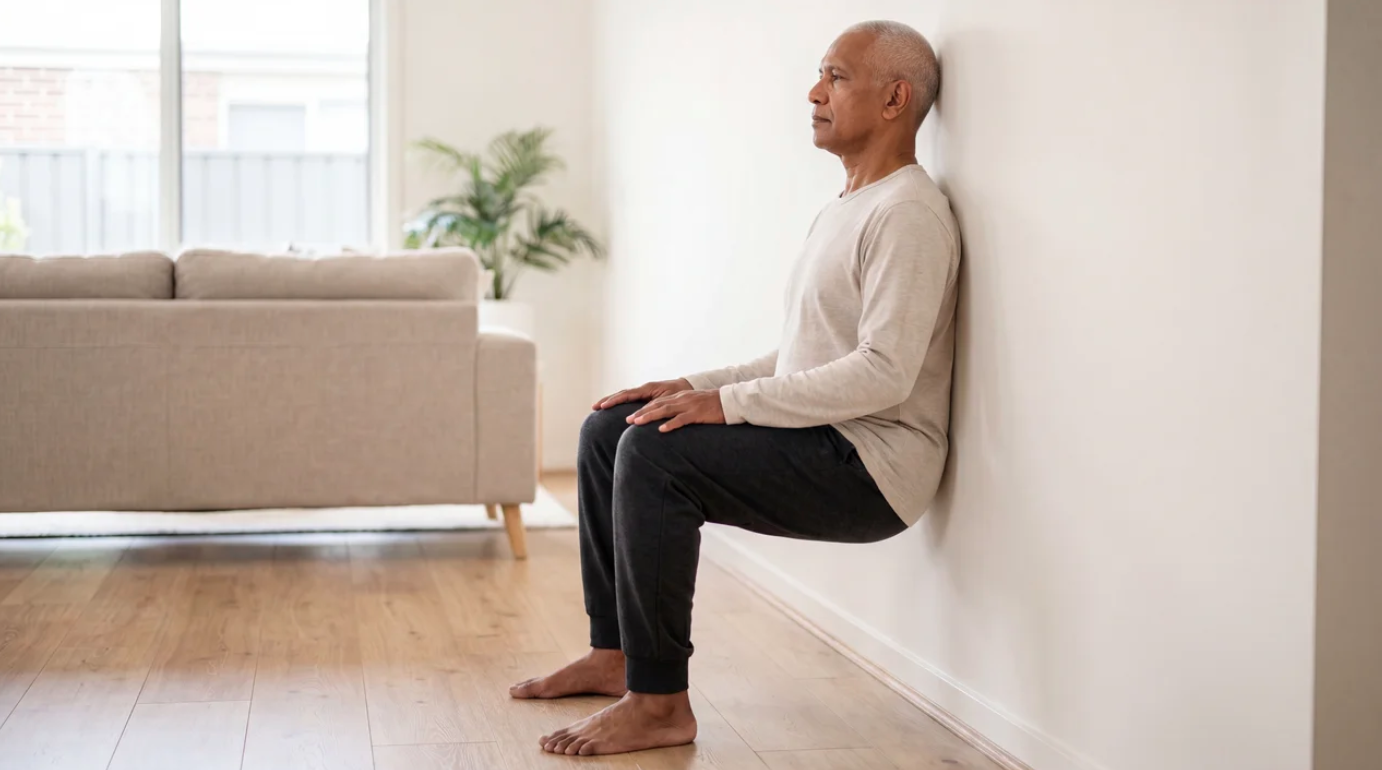
Wall sits are brilliant for the quads, the muscles that directly support and control the knee. Because the whole thing is held against a wall, you have full control over how hard it feels in real time. Slide higher, it's easier. Slide lower, it's harder. Simple.
How to do it:
- Stand with your back flat against a wall.
- Step your feet out roughly half a metre, about hip-width apart.
- Slide down the wall until your knees are comfortably bent, anywhere from a gentle bend to a 90-degree angle.
- Hold.
- Slide back up the wall to rest.
The Dose: 3 sets of 20 to 45 second holds.
Want a guided knee and hip routine to follow? If you'd like to get started alongside our physio team, with full demonstrations, pacing and modifications built in, that is exactly what our free 55+ Video Series is for.
Start the Free 55+ Video Series →Putting It All Together
You can run this entire routine from your lounge room. A sturdy chair, a wall, and a single step. That's the whole equipment list.
Aim for two to three sessions a week. A full session looks like this:
- 3 sets of 8 to 15 Heel raises
- 3 sets of 8 to 15 Sit-to-stands
- 3 sets of 8 to 15 Glute bridges
- 3 sets of 8 to 15 Step-ups (per leg)
- 3 sets of 20 to 45 second Wall sits
For each exercise, choose a variation that makes the last two or three reps feel genuinely tough. If you're finishing comfortably, take that as your cue to progress. A harder variation, a few more reps, or a little added weight.
Keep this up for six to twelve weeks and you'll get stronger legs, less knee and hip pain, better balance, and a lot more confidence on your feet.
A reminder from our team"Plenty of people come to me convinced that strength work is the last thing their knees need. Six weeks later they're loading up their sit-to-stands and telling me how much easier the stairs feel. There's no secret to it. Pick a level you can manage today, then add a little each week."
Brodie Morrison, 55+ Expert Physiotherapist, Be Mobile Physiotherapy
The Bottom Line
When your knees or hips start hurting, the natural response is to ease off. Skip the stairs where you can. Walk a bit less. Become a bit more careful with everything.
It feels sensible. It's quietly making the problem worse.
The legs and joints of over-55s respond to the opposite approach. They get stronger when you ask more of them.
Begin with what you can manage today. Add a little next week. Stick with it. 💪
Ready to give it a proper go? Our free 55+ Video Series includes a complete follow-along workout designed for knee and hip strength, guided by our physio team, so you can build confidence safely from day one.
Get the Free 55+ Video Series →